The Friendship of Franklin D. Roosevelt and Alfred E. Smith

09-1657M

I am currently working on a project to better understand the relationship between Franklin D. Roosevelt and Alfred E. Smith. These two dynamic men resided in politics during turbulent and changing times, and their influence on one-another undoubtedly influenced each other’s politics. I expect to complete this project by fall, 2016. If you would like to learn more about my work in relation to this project, please email me at stewhistory@gmail.com.

Posted in Forthcoming Publications | Leave a comment

Cuban Missile Crisis: How the Soviets Almost Got Away With It

Speaking to the vast amount of analysis and reflection that has been made on the Cuban Missile Crisis, President John F. Kennedy’s National Security Advisor, McGeorge Bundy, observed, “Forests have been felled to print the reflections and conclusion of participants, observers, and scholars.”[1] However, far less has been written about John C. McCone, Director of the Central Intelligence Agency (CIA), and the seemingly flawed intelligence in the lead up to the Crisis. On the morning of October 16, 1962, Kennedy and several of his top advisors met to discuss photos that a U-2 plane captured just two day earlier while flying over the island of Cuba. These photos revealed Soviet launch pads that presumably would be used for launching Medium and Intermediate Range Ballistic Missiles (MRBMs and IRBMs) capable of carrying nuclear warheads. This sobering revelation of an extensive military buildup had begun months prior, so why was the president just learning of it? What was going on with US intelligence? The CIA had been gathering information on Cuba through agents and informants, as well as through a plethora of reports coming in from Cuban exiles and citizens. With such an emphasis placed on intelligence, how could so many clues simply slip by? While it is tempting to blame the CIA for its failed intelligence to “discover” this information prior, the CIA had many reports concluding a Soviet arms buildup on the island was underway months before the situation culminated in a crisis. McCone had been warning officials for months prior to the October discovery and then shockingly went on a month long vacation in Southern France in September. The poor use of known intelligence, restricted use of U-2 planes, a distracted Kennedy administration, and a general conservative culture within the intelligence community is to blame for the delayed reports of IRBM and MRBM launch pad sites during the Cuban Missile Crisis.

There is an overabundance of historical narratives written about the Cuban Missile Crisis, each offering its own conclusions. However, the role of the CIA has only been mentioned in passing.[2] Nonetheless, there are some useful conclusions that must be considered. Historian Raymond Garthoff claims that perhaps the CIA’s biggest downfall in the Cuban Missile Crisis was its failure to anticipate the Soviet Union placing offensive missiles in Cuba.[3] Reporter and historian Michael Dobbs believes there was too much intelligence coming in for the CIA to make any accurate conclusions from it. Much of it was contradicting or too outlandish to be credible. With so many reports coming in from CIA agency networks (AMTORRID and COBRA), the CIA was simply overwhelmed.[4] One of the most referenced books on the Cuban Missile Crisis, Graham Allison and Philip Zelikow’s Essence of Decision: Explaining the Cuban Missile Crisis, marvels at “… how extraordinary it was that the Soviet missiles were discovered at all. Their discovery was possible only because of the special organizational capacities, routines, and procedures of the U.S. intelligence community.” While Essence of Decision explains the procedures of the way intelligence was collected and used, it fails to consider the possibility of a flawed intelligence community. Like Dobbs, Allison and Zelikow claim too much intelligence (only marginally important and much of it false) was the reason why the missiles were not discovered sooner.[5]

There were four main sources from which the intelligence community was able to gain knowledge about Soviet arms buildup in Cuba. U-2 surveillance, monitoring ships and the goods they were carrying into Cuban harbors, intelligence gathered from CIA agents and spy networks, and information provided by Cuban refugees. If historians are claiming there was too much intelligence, an obvious question arises. If a system is designed to gather intelligence and resources allocated to meet its needs, why was there not a better system to sort the abundance of intelligence? Clearly, the system was defective. Perhaps even with such a flawed system, McCone’s insistence that the Soviets were placing offensive weapons in Cuba might have had a significant impact on top administration officials had McCone not been absent from Washington. Even so, historian Christopher M. Heist claims, “McCone’s ‘crusade’ during the summer and fall of 1962 was a primary reason for the early discovery of the missiles.”[6] With the release of declassified CIA documents and a great deal of historical research accomplished, it is time to re-examine the CIA’s role in the Cuban Missile Crisis.

Fidel Castro’s revolutionary forces took power in 1959, nationalizing many American businesses. He sanctioned a socialist form of government, which soon turned to an endorsement of Soviet Communism. In turn, this troubled President Dwight D. Eisenhower. Eisenhower, who is known for his use of clandestine military actions to solve hostile situations, initiated planning for the covert operation of the Bay of Pigs. When Kennedy became president in 1961, he continued the U.S. policy of medaling in Cuba and followed through with the Eisenhower administration’s Bay of Pigs invasion. The CIA trained Cuban exiles to launch an invasion on the southern part of the island. Anti-Castro civilians on the island would then rally around the invaders to overthrow the Cuban government. However, the CIA failed to recognize that most of the civilians who had strong feelings against the Castro regime had already fled Cuba. The Bay of Pigs was a disaster and an enormous embarrassment for the United States, the Kennedy administration, and the CIA. Arguably this may have sparked the idea that the Soviet Union needed to protect its communist friends in the Caribbean by placing missiles on the island.

Following the Bay of Pigs, the Kennedy administration established Operation MONGOOSE headed by Attorney General Robert F. Kennedy. The mission, in essence, was a covert CIA operation intended to rid Cuba of both Castro and communism. It included assassination attempts of Castro, such as a fungus-infected wetsuit and a poisoned cigar. Arguably, one of the greatest assets Operation MONGOOSE had for McCone was its intelligence component. The operation included the use of U-2 planes that could track shipments into Cuba on Soviet ships. The planes took pictures of shipments, and used a computerized “crate-ology” system to determine undisclosed crates on board. While this state-of-the-art technology successfully identified some Soviet cargo on board, it failed to identify the Soviet MRBMs and IRBMs below deck.[7] Aside from the photoreconnaissance technology, the operation also relied on first-person accounts (both from intelligent agents in Cuba and from refugees). While Operation MONGOOSE never successfully eliminated Castro, it caused him to become extraordinarily cautious about Cuba’s contentious relationship with the United States and probably led to his increased demand for Soviet aid to defend Cuba.

Another direct result of the failed Bay of Pigs invasion was the firing of CIA director Allen Dulles, who had been the director under Eisenhower. McCone, who has been described as a “hawkish Republican,” was appointed as the new director.[8] Despite the seemingly conflicting political association between McCone and the president, the two families had become close during the illness and death of McCone’s first wife Ethel.[9] Both the Kennedy family and McCone were devout Catholics, which only helped to solidify their relationship. Robert Kennedy and McCone would later have a falling out. However, following the death of Ethel, the Kennedy’s and McCone were able to develop a strong personal relationship.[10]  Once he became Director of Central Intelligence (DCI), McCone set to task on updating the agency and making it more efficient. He made widespread changes, including the elimination of an intercom system that frequently interrupted the director, replaced some of Dulles’ division chiefs and deputies, and lobbied the Pentagon for more support in the use of intelligence planes.[11] He was one of the first members of the intelligence community to predict and discover the missiles. Having come from the Atomic Energy Commission, McCone had a great deal of knowledge in the importance of nuclear weapons and was frequently outspoken about their use.[12] There is no evidence that McCone ever withheld information from the president. Moreover, he worked incredibly hard to remove the restrictions that had been placed on U-2 missions in the preceding months, which had been suspended largely for political reasons.

President Kennedy was highly political, and 1962 was a mid-term election year. Two years earlier, he had strongly criticized the Eisenhower administration for not doing enough to challenge the Soviet threat. Now he now was facing the same criticism from Republicans (brought about largely by his decision not to send U.S. forces into Cuba after the Bay of Pigs). He was genuinely concerned about the mid-term elections. Presidential historian Richard Reeves suggests that Kennedy’s focus on politics greatly hindered his ability to concentrate on Cuba and that the Soviets were able to sneak in missiles because the president was distracted with politics. Reeves claims that Kennedy was mostly concerned with Republican Senator Kenneth Keating, who was suggesting that Kennedy was too soft on the Soviets. In response, Kennedy started his September 13 news conference in a strongly worded warning:

“I would like to take this opportunity to set the matter in perspective…. It is Mr. Castro and his supporters who are in trouble. So it is not surprising that in a frantic effort to bolster his regime he should try to arouse the Cuban people by charges of an imminent American invasion…. I will repeat the conclusion that I reported last week: that these new shipments do not constitute a threat to any other part of this hemisphere…. We shall neither initiate nor allow aggression in this hemisphere…. I have indicated that if Cuba should possess a capacity to carry out offensive actions against the United States, that the United States would act.” [13]


Senator Keating stood on the Senate floor and accused the Soviet Union of sneaking thousands of troops and torpedo boats into Cuba. The president was sure that the CIA had leaked the information, and he remarked, “Those CIA bastards… I’m going to get those bastards if it’s the last thing I do.”[14]

Time magazine was publishing classified CIA and State Department documents on Cuba. Other newspapers were reporting similar stories. On September 3, 1962, The New York Daily News headlines included, “REDS CONFIRM BUILDUP IN CUBA.” The article reported that the USSR had given Cuba Surface-to-Air-Missiles (SAMs) and suggested that missile bases might be under construction.[15] In a press conference on August 29, reporters asked questions about the presence of Soviet troops and military equipment in Cuba. Kennedy denied Keating’s earlier accusations of the presence of Soviet troops and explained that the Soviet Union and Cuba were working on “an expanded advisory and technical mission.”[16] Despite public denials of Soviet military and weapons in Cuba, the Kennedy administration was aware of increased Soviet activity on the island.

Notwithstanding reports of military equipment being shipped into Cuba, the intelligence community frequently came to the same conclusion: any Soviet buildup of weapons in Cuba would be unlikely or inconsistent with what the Soviet Union had done prior. On August 10, McCone met with Secretary of State Dean Rusk and reported that there was an unexpected importation of distinctive electronic material used in MRBMs  into Cuba.[17] Ten days later, the CIA acknowledged,

“It appears that between 4000 and 6000 Soviet/Bloc personnel have arrived in Cuba since 1 July. Many are known to be technicians, some are suspected to be military units, as such, being included…. Unloading of ships takes place under maximum security, with the Cuba population excluded from the port areas. Large equipment is noticeable; large crates have been observed which could contain airplane fuselages or missile components.”[18]


In a Special National Intelligence Estimate titled “The Military Buildup in Cuba” written on September 19, it was noted that the Soviet Union was supplying arms to Cuba in order to secure the Cuban regime from another U.S. invasion, or a U.S. backed coup d’etat against Castro. However, providing MRBMs and IRBMs in Cuba would be “incompatible” with previous USSR practice:

“The USSR could derive considerable military advantage from the establishment of Soviet medium and intermediate range ballistic missiles in Cuba, or from the establishment of a Soviet submarine base there. As between the two, the establishment of a submarine base would be the more likely. Either development, however, would be incompatible with Soviet practice to date and with Soviet policy as we presently estimate it. It would indicate a far greater willingness to increase the level of risk in US-Soviet relations than the USSR has displayed thus far, and consequently would have important policy implications with respect to other areas [Berlin] and other problems in East-West relations.” [19]


Had the intelligence community and the Kennedy administration believed that the Soviets were, in fact, placing offensive missiles in Cuba, there undoubtedly would have been a greater demand for increased intelligence. In turn, the missiles would most likely have been discovered earlier.

Garthoff argues that perhaps the reports, “should have concluded that the Soviet leaders probably would not place nuclear missiles in Cuba. At the same time, however, it would have given more weight and attention to the possibility that they would do so.”[20] One obvious flaw in this argument comes to mind that McCone must also have recognized. Simply because hitherto, the Soviet Union had not done something did not mean that they could or would not try something new. Unfortunately, the rationale reasoning that the Soviet Union would not place offensive weapons in Cuba was a direct result of the very conservative culture within the intelligence community.

When President Harry Truman founded the CIA and the National Security Council (NSC), it was expected that there would be a cozy cooperation between the two agencies. The CIA would gather intelligence and provide analysis, while the NSC would make decisions based on that analysis.[21] Truman also established the Office of National Estimates (ONE) to be a semi-independent component of the CIA. ONE would provide estimates by asking questions on intent and “probable development.”[22] What was unique about ONE, different from other federal intelligence agencies, is that it was comprised of the highest-ranking civil servants, men who were free from most political duties, free from the burden of annual budgets, free from questioning before Congressional committee’s, and had no administrative duties. Their responsibility has been described as, “brood[ing] about the world’s problems and to project their views about how these problems are likely to affect American national security interests.”[23] ONE also created the National Intelligence Estimates (NIE) and the Special National Intelligence Estimates (SNIE). The Defense Intelligence Agency (DIA) was created a year before the crisis under the Department of Defense. The National Security Agency (NSA), which dealt largely with communication intelligence, and the Bureau of Intelligence and Research were created under the Department of State.[24] With so many intelligence agencies working mostly independently of each other, one can understand how information might have been processed in a chaotic, inefficient manner – inherent of many bureaucratic establishments.

Those who use gathered intelligence are often political figures (such as the NSC and the president). However, analysts make conclusions based on what they are given, rather than on what they think might be politically beneficial.[25] President Kennedy’s political influences combined with his remarkable quest for knowledge led him to rely less on the NSC than his predecessors.[26] Rather than using the NSC as a means of consultation and advising, Kennedy used them as a way to communicate already-determined decisions made in smaller groups within his political inner circle.[27]

As previously established, the nature of the intelligence community was very conservative. CIA historian Scott D. Breckenridge describes a conservative intelligence community as controlling the imagination and “limiting the liberties to be taken with what is known.”[28] Consistently, the intelligence community claimed that simply because the Soviet Union had never placed missiles outside of the Soviet bloc before, it was not likely that they would do it now. There was hard, known evidence to which the intelligence community did not pay heed. The culture of the CIA (with the exception of McCone) focused on what was most likely to happen, thus limiting the possibility of other scenarios (notably, the possibility of Soviet offensive weapons in Cuba).  Princeton University Professor Klaus Knorr describes a situation where anticipations do not apply to known facts as “philosophical predisposition”[29] This certainly describes the intelligence agency during the months the Soviet Union was deploying missiles in Cuba. Prior to the deployment of missiles in Cuba, the Soviet Union had never sent missiles outside of the Soviet bloc. While the intelligence community did not think that the Soviets would deploy missiles to Cuba, information gathered from AMTORRID and other sources contradicted U.S. assumptions.

On August 20, McCone reported definite presence of SAMs in Cuba. To many in Washington, it did not come as a big surprise. Nine days later it was reported in the New York Times that large shipments of Soviet military equipment to Cuba had been underway since late July.[30] The State Department believed that the SA-2’s were solely for defensive purposes; McCone thought otherwise. He met with Kennedy the following day and told him that he thought the SAMs could only be cover up of larger offensive weapons. He reiterated his concerns in a letter to Kennedy stating, “The only construction I can put on the missiles going into Cuba is that the Russians are preparing to introduce offensive missiles. I question the value of SAMs except as the means of making possible the introduction of offensive missiles.”[31] On August 25, McCone recommended to Deputy Director of Intelligence General Marshall S. Carter that he urge the administration to allow more U-2 flights to inspect the progress of the SAM sites. With that, McCone left Washington to marry his second wife, Theiline Pigott, in Seattle on August 29. Following their wedding, they left for the French Riviera for a month-long honeymoon.[32]

It is very surprising that someone who was so worried and convinced that the Soviets were building offensive missiles in Cuba and protecting them with SAM missiles left for a month-long vacation out of the country. One can only have sympathy for McCone having lost his first wife and eager to marry his second. Doubtless, he loved Theiline and was anxious to spend time with her away from Washington. However, in the context of such an intense prelude to the Cuban Missile Crisis, one would think he would feel obligated to stay in Washington, especially as the development of the SAM sites and rumors of missiles in Cuba increased (CIA reports, which McCone presumably read, also showed this). Carter would convey McCone’s wishes at various meetings while he was gone. Perhaps McCone felt confident that Carter would lobby for increased use of the U-2’s.

McGeorge Bundy, National Security Advisor, later gave some insight as to why McCone left for his lengthy honeymoon at such an important time. Bundy calls McCone an “exceptional” member of the Kennedy administration because of his early feelings that the Soviets were planning something:

“…. [McCone’s] anxiety did not arise from bureaucratic wariness in his agency; his professionals did not agree with him, and I never knew McCone to try to bend their assessments to match his own opinions. He pressed his case as an individual, not as a representative of the agency, but he pressed it energetically.”[33]


In fact, while Bundy was in Paris (and McCone on his honeymoon), McCone called upon Bundy to join him for a walk where he again stressed his argument that he believed the Soviets were placing missiles in Cuba. He also pressed for an increase in surveillance (U-2’s).[34] McCone was well-known for getting things done in a forceful manner. He had to have known that a face-to-face dialogue would have procured more support in the use of U-2’s. Regardless, McCone’s absence from Washington definitely had an impact on intelligence gathering.

On October 27, 1960, President Eisenhower authorized the first U-2 mission over the island of Cuba. The use of the U-2 was controversial. In essence, it was a spy plane, and when flown over another country, it would violate that country’s sovereignty. In an October 8 memorandum for the Director of Intelligence, Sherman Kent, Chairman of the Board of National Estimates noted, “The Soviets and Cubans would make every effort to shoot down any reconnaissance vehicle that came over Cuba…. Having international law on their side, they would hope to achieve a UN condemnation of the United States for acts threatening peace.”[35] More concerning, however, was the top secret technology on board. If a plane were to be shot down, would the technology fall into the hands of an adversary? These were all questions being contemplated by top intelligence advisors. The U-2 technology required fair weather to operate, and the CIA monthly forecast determined when U-2 planes would fly. As the Soviets began their arms buildup in Cuba, it was decided that two missions per month would fly over Cuba. U-2s would not fly unless overcast was predicted to be less than 25 percent.[36] Unfortunately for the United States, hurricane season was nearing, and the weather over Cuba was particularly cloudy during the late summer and early fall of 1962. In fact, two of four planned U-2 flights over Cuba in September were cancelled because of poor weather.[37]

Weeks before the missiles were discovered in Cuba, the U.S. Air Force had taken over reconnaissance flight missions. While Garthoff claims that it had no impact, one can only doubt that had McCone been in charge of them, they might have occurred more frequently.[38] U-2 photography of August 29 confirmed the existence of SAM’s and guided missile boats. According to photograph interpreters, the photos disclosed the existence of tanks, self-propelled guns, the arrival of more troops, and validated predictions that SAMs would be ready in the near future.[39] Despite the availability of such technology and an acknowledgment of Soviet military expansion in Cuba, restrictions were placed on the use of U-2 missions. Consequently, this decision hindered the intelligence community’s ability to find Soviet missiles in Cuba sooner. Reflecting back on the months before October 14, McCone later explained, “In planning for any U-2 operation over well-defended, denied territory, we were always aware of criticism that attended the U-2 incident over the USSR in May of 1960. The two incidents involving the straying of a U-2 over Sakhalin on August 30 and the loss of a Chinese Nationalist U-2 over the China mainland on September 8 served to sharpen the already existing apprehension.”[40]

The two incidents involving top-secret, sensitive U.S. technology occurring within just days of each other caused alarm for Rusk. As previously established, U-2 missions were very controversial because they violated other countries’ sovereignty. It was a diplomatic tribulation with which Rusk would have to deal. Furthermore, the Bay of Pigs made the United States appear as an aggressive nation towards Cuba. There were real diplomatic repercussions that resulted in U-2 flights over the island. On September 10, the Secretary of State called for a meeting regarding scheduled U-2 missions in Cuba. Carter, acting director of the CIA in McCone’s absence, urged the flights to continue as scheduled.

Several historians and McCone himself have mentioned the tension that existed between the Director of Central Intelligence and the Air Force. While both scholars and McCone are silent on why this friction existed, one can speculate on the reasons. McCone may have been seen as an outsider. He was a strong Republican in a Democratic administration. He had also only been Director of Central Intelligence since November 1961. Perhaps some were weary to trust a man of such little experience as DCI. However, it is most likely that the stain of the Bay of Pigs still resonated within the administration. The CIA had let the president down, so why would they trust the head of that agency on allegations of offensive Soviet weapons in Cuba? The diplomatic pressures of the Department of State undoubtedly influenced Rusk’s decision to restrict U-2 missions. Even while this tension existed between the DCI and other administration officials, McCone still had a great deal of influence within the intelligence community.

The U-2 flights over Cuba would have covered areas where intelligence planes had not flown in over a month. Carter argued for a long flight around the edge of Cuba and overhead. A compromise was made that allowed for four flights: two over international water and two speedy flights over Cuba. Unfortunately for Carter and McCone, the agreement was not written down. The compromise made on September 10 would not fully be carried out because Rusk delayed the overhead flights by proposing they be sponsored by the Organization of American States (OAS). Carter again lobbied for more intelligence flights on September 20; Rusk was opposed. Secretary of Defense Robert McNamara pushed for the control of the U-2’s to be transferred over to the Strategic Air Command (SAC). He argued that if a plane were to be shot down, it would be less embarrassing if it were under the command of the Air Force than the CIA. Carter was strongly opposed; however, SAC won out. Had McCone been present at these essential meetings deciding the fait of U.S. intelligence in Cuba, the CIA may have been more successful in procuring more intelligence flights over the island. When McCone returned, he was able to obtain approval for more flights over the periphery of Cuba, which discovered costal defense installations.[41]

With a conservative culture within the intelligence community, it is easy to see why such incidents would have slowed or even halted U-2 flights. In an October 5 meeting with Carter and Lansdale, the Director of Central Intelligence stated that the restriction on U-2 planes had positioned the U.S. intelligence community in such a rut, that it was unable to confirm or investigate the presence of offensive capabilities in Cuba.[42] McCone was concerned about the infrequent U-2 missions and most importantly, that no U-2 flights had been conducted over the center or western part of the island for a month. After much insistence from McCone, the Joint Chiefs of Staff decided on October 9 to allow U-2 planes to fly south to north and over the western section of Cuba.[43]

The CIA had been gathering a plethora of details on Soviet ships coming into Cuban harbors carrying Soviet weaponry, tanks, and troops in the months prior to the discover of MRBMs and IRBMs in Cuba. Human intelligence (HUMINT) played a significant roll in this discovery. However, HUMINT must provide new information that is reliable in order for it to be used.[44]  Foreign diplomats and Cuban exiles were reporting increased military activity on the island. When Cuban refugees reported said information, it was most commonly at an intelligence headquarters located at an airport in Miami call Opa-Locka. Opa-Locka became an interrogation center for refugees in February 1962. It would take information from one refugee and compare the results to another’s. There were thousands of refugees interrogated. In May, Opa-Locka established a system that would identify specific locations in Cuba, which would be then recommended for aerial surveillance. In August, another system was established to create a card file on specific Cuban locations. Such a card was established on San Cristobal (one of the first missile sites to be completed) on October 1.[45]

Some of the reports from Opa-Locka were false. While Allison and Zelikow claim that refugees intentionally gave false information, they fail to substantiate evidence to their claim.[46] Interestingly, neither other historians, nor the CIA have made this claim. One refugee reported, “After about every third truck there was a long flatbed pulled by a tractor-like vehicle. On each vehicle there was a round object as tall as a palm tree and covered by a tarpaulin…” The CIA periodically opened mail correspondences, which revealed that between the last few days of July and the beginning of August, over a dozen ships had docked in Havana.[47] An eyewitness reported “large intercontinental rockets more than 20 meters long” being unloaded from a Soviet ship. The CIA determined “it is more likely that source observed [SAM] missiles being offloaded.” It is now known that these were R-12 rockets. Eight of these were unloaded in the Mariel on board Soviet freighter Poltava.[48] One report processed at Opa-Locka indicated that there was an increase in Soviet cargo ships to Cuba riding high (suggestion a light, hulking cargo such as MRBMs and ICBMs), which were unloaded under the guise of nighttime darkness.[49]

Despite the seemingly obvious conclusions of the reports, the CIA did not investigate further into what was actually happening in Cuba. The agency noted that there were so many reports coming in, they could not possibly look into everything being reported. AMTORRID agents in Cuba would write their observations in a secret code or use “secret techniques” in the form of a letter. They would then mail that letter to a destination outside of the United States. The mail would arrive at designated CIA drop-offs where the agency would then forward the mail to the CIA headquarters. There, agents would decipher and read the reports.[50] What did not happen, and perhaps should have happened, was a file-creation system for different types of categories of reports. Then, reports from agents should have been compared with reports from Opa-Locka and correlations made. AMTORRID and COBRA agents had reported the presence of military equipment in Cuba long before the Soviets began to place SAMs and missiles in Cuba.[51] The CIA suggests that it was flooded with information that proved to be unreliable. Interestingly, Cuban ambassador to the United Nations Carlos Lechuga notes that the Soviets had been supplying Cubans with light weapons, artillery mortars, tanks, self-propelled cannons, and other supplies before 1962.[52] Lechuga, being part of the Cuban government, would have no reason to be deceptive in his claim. Therefore, it is perhaps likely that the reports the CIA gathered from AMTORRID agents believed to have been false and unreliable may actually have been true.

Shortly after Castro’s takeover in 1959, a novel written by Graham Greene describes a vacuum cleaner salesman who was paid a great deal of money by a British government intelligence agency for the “secret” sketch of a “rocket launching pad” supposedly in Cuba. The sketch turned out to be a drawing of the inside of a vacuum cleaner.[53] While this was a book of fiction, it does give us insight as to how some in the agency may have been feeling. After all, the agency had received 882 reports in September alone of internal activities in Cuba.[54] Nonetheless, an increase in intelligence should have provoked some concern and should inevitably have increased the need to re-examine how information was being sorted and used.

One seemingly obvious flaw with the CIA’s claim that a flood of information, much of it false, prevented the intelligence community from gathering useful information is that the agency had a defective system of sorting intelligence. Priority National Intelligence Objectives (PNIOs) was the main system the intelligence community used to sort gathered information. There were initially three levels of information, with a fourth added in the early 1960s. Soviet foreign policy and military were at the top of these priorities. Later, in 1966, PNIOs was considered ineffective.[55] This very broad system of categorizing information only moved all Soviet-related intelligence to the top of the list. What was then done with that information? Even though historians and the CIA agency itself have hidden behind the convenient scapegoat that too much information, most of which was unreliable, explains the failed intelligence leading up to the Cuban Missile Crisis, the CIA received enough information which should have caused alarm.

On September 9, aboard the Soviet Omsk docked in the Calsilda with 6 R-12 rockets, a member of AMTORRID overheard Castro’s personal pilot, Claudio Morinas, claim that Cuba had, “many mobile ramps for intermediate-range rockets… [Americans] don’t know what’s awaiting them.”[56] While at the United Nations, the Castro stated that Cuba had, “weapons that we did not need and that we do not want to use.”[57] Cuban officials reported to British journalists that there were “missiles on Cuban territory whose range is good enough to hit the United States and not only Florida.”[58] Even the Cuban newspaper Revolution headlined on September 12, “ROCKETS WILL BLAST THE UNITED STATES IF THEY INVADE CUBA.”[59] A very tactical element of deception is to provide “false” information to one’s enemy. Perhaps the CIA believed that the Cuban government was purposefully deceiving the CIA by exclaiming statements involving a Soviet arms buildup in Cuba. However, the agency does not mention this in any of its declassified documents. Therefore, it is likely that the agency could not handle the information that it was given, some of it clearly true. Furthermore, the system established to sort and forward relevant information was flawed.

On October 14, a U-2 flew over the western part of Cuba. One day later, the photos were interpreted and yielded a spine-chilling conclusion. The missions discovered two disclosed arches in the Sierra del Romario Mountains that contained Soviet MRBMs and spotted a military encampment nearby with 15 smaller tents and 75 vehicles (significantly, six canvass covered trailers of 80 feet-the size to transport Soviet SS-3). The photographs also revealed another nearby site with eight trailers, four special vehicles that could be used to erect a missile, 20 small tents, 10 large trucks, 16 small trucks, and 12 unidentified pieces of large equipment.[60] President Kennedy was notified on the morning of October 16 and took immediate action.

While the crisis remarkably ended without the United States, Cuba, or the Soviet Union firing a single nuclear weapon at each other, it was one of the most dangerous periods in known history. The CIA continued to provide information to the president and members on his crisis advisory board, the Executive Committee (EXCOM), so they could make educated decisions on the volatile situation in Cuba. They still failed to give an accurate account of total Soviet military capability on the island. For example, the CIA believed that there were only 6,000-8,000 Soviet troops on the island.[61] The military planned an invasion based on that number. In 1988, it was discovered that 42,000 Soviet troops had been stationed on the island. The CIA was not able to find any nuclear weapons and believed that the Soviets did not have any in Cuba. Also in 1988, it was discovered that 60 nuclear warheads for IRBMs and MRBMs, 100 tactical nukes, 80 nuclear warheads for cruise missile launchers, and 12 for the Luna rockets had been on the island. Perhaps more thorough intelligence gathering prior to the crisis would have been able to more accurately determine what was on the island of Cuba. While the matter of CIA intelligence during the Crisis is a matter for another paper, it should be understood that a faulty intelligence system that nearly left offensive weapons undetected in Cuba is also responsible for inaccurate intelligence during the throughout the Crisis.

Lechuga later reflected on the surprise that the Soviet and Cuban governments were able to deliver.

“During the first phase of the operation there were no leaks; it was impressive how thousands of men, equipment, missiles, planes and torpedo boats were sent from Soviet ports to Cuba to their final destinations, without the intelligence services of the United States and its allies learning of the true dimensions and nature of the huge maneuver. The first troops arrived in August 1962, and the missiles in September, but it wasn’t until mid-October that the U-2s photographed the missile installations, by which time some of them were already operational.”[62]


In February of the following year, the president’s Foreign Intelligence Advisory Board also reflected on the job of the CIA. In this report, known as the Killian Report, they recognized the CIA’s “high performance” the agency was able to achieve under such critical circumstances. However, the report admits a problem of maintaining high performance in between the crisis. The Killian Report also noted that the CIA should have been more efficient in “obtaining adequate and timely intelligence as to the nature and scope of the Soviet military build-up as it developed over a period of months, and exploiting the available intelligence as a basis for estimating Soviet and Cuban plans and intentions.”  The report also acknowledged that the CIA failed to gather information with a sense of urgency, and that that might have “stimulated a greater effort” had that been done.[63] The Killian report went on to criticize the CIA’s inability to properly use agents and their information to determine intentions. It recognized that the inclement weather was a factor in poor use of U-2s but acknowledged that between September 8-16, missions were wrongfully suspended.[64]

Just weeks following the Killian Report, McCone wrote a candid response to the criticisms of the report. McCone was very defensive toward his earlier position on U-2 restrictions. He especially did not want to see them restricted anymore than they had already been. He also reiterated his personal belief that he thought that the Soviets were placing offensive weapons in Cuba all along. McCone expressed anger at the State Department for its failure to estimate what the other “fellow” would do or not do. McCone believed there was too much intelligence coming in. He noted that in just two years, there were over 3,500 agents reporting missile in Cuba, of which very few were accurate.[65]

Without much difficulty, one could blame the CIA for it’s inadequate ability to “discover” offensive missiles in Cuba before the situation became critical. While the CIA had many reports of a Soviet arms buildup on the island, they were unable to successfully distinguish incoming reports of missiles as being either true or false. Furthermore, the agency’s failure in organizing and comparing similar intelligence reports demonstrates nothing less than a faulty intelligence system. McCone’s absence also did not help levy any push for more reconnaissance missions over Cuba. The tensions he had with the conservation culture of the intelligence community also prevented an increase in reconnaissance missions. President Kennedy’s political agenda surely distracted him from intelligence reports and Soviet intentions in Cuba during the election campaigns of 1962. However, the restricted use of U-2 planes greatly hindered US intelligence to detect SAM sights on the western portion of the island until they had already been operational. There is no single person or agency solely at fault. Nevertheless, the CIA, which is responsible for gathering intelligence for the United States to look after it best interests, failed to detect offensive missiles in Cuba until the Crisis had nearly reached its pinnacle.

Bibliography

Allison, Graham T., and Philip Zelikow. Essence of Decision: Explaining the Cuban Missile Crisis. (New York: Longman Publishing), 1999.

Blight, James G. and David A. Welch, editors. Intelligence and the Cuban Missile Crisis. (Portland: London Publishing), 1998.

Breckenridge, Scott D. The CIA and the U.S. Intelligence System. (Boulder: Westview Press), 1986.

Bundy, McGeorge. Danger and Survival: Choices About the Bomb in the First Fifty Years. (New York: Random House), 1988.

Clark, Robert M. Intelligence Analysis: A Target-Centric Approach. (Washington: CQ Press), 2004.

Cooper, Chester L. “The CIA and Decision Making.” Foreign Affairs. 50:2. (January 1972), 223-236.

Dobbs, Michael. One Minute to Midnight: Kennedy, Khrushchev, and Castro on the Brink of Nuclear War. (New York: Random House, Inc.), 2009.

Douglas, James W. JFK and the Unspeakable: Why He Died and Why it Matters. (New York: Touchstone Publishing), 2008.

Fursenko, Aleksandr and Timothy Naftali. “One Hell of a Gamble:” Khrushchev, Castro, and Kennedy, 1958-1964, The Secret History of the Cuban Missile Crisis. (New York: W. W. Norton and Company), 1997.

Heist, Christopher M. “John McCone and the Cuban Missile Crisis: August 1- November 3, 1962.” M.A. thesis., Liberty University, 2010.

Lechuga, Carlos. Cuba and the Missile Crisis: The Dramatic Inside Story by Carlos Lechuga, Cuba’s UN Ambassador. (New York: Ocean Press), 2001.

May, Ernest R. and Philip D. Zelikow. The Kennedy Tapes: Inside the White House During the Cuban Missile Crisis. (Cambridge: Belknap of Harvard University), 1997.

McAuliffe, Mary S., editor. CIA History Staff. CIA Documents on the Cuban Missile Crisis: 1962 (Washington: Ross & Perry, Inc.), 2001.

Murphey, David E. Battleground Berlin: CIA vs KGB in the Cold War. (New Haven: Yale University Publishing), 1997.

O’Neal, Michael. “Reds Confirm Sending Arms, Troops to Cuba,” New York Daily News. September 3, 1962.

Reeves, Richard. President Kennedy: Profiles of Power. (New York: Touchstone Publishing), 1993.

Stern, Sheldon. The Week the World Stood Still: Inside the Secret Cuban Missile Crisis. (Stanford: Stanford University Press), 2005.

Topping, Seymore. “Moscow Discloses Shipments to Cuba Will Double in ’62,” New York Times. August 29, 1962.

Vincent,E. Duke. The Camelot Conspiracy: A Novel of the Kennedy’s, Castro, and the CIA. (New York: Derby Publishing), 2011.


[1] McGeorge Bundy. Danger and Survival: Choices about the Bomb in the First Fifty Years.  (New York: Random House Publishing, 1988), 391.

[2] The CIA’s role in intelligence gathering during the Cuban Missile Crisis only appears briefly in one of the most revered, analytical works on the crisis, Allison Graham and Philip Zelikow. Essence of Decision: Explaining the Cuban Missile Crisis. (New York: Longman Publishing, 1999). 219-224. Michael Dobbs briefly mentions it in Michal Dobbs. One Minute to Midnight: Kennedy, Khrushchev, and Castro on the Brink of Nuclear War. (New York: Vintage Books, 2009), 120-123. Surprisingly, there have been no

solid historical works analyzing the successes and failures of the intelligence community.

[3] Raymond Garthoff in James G. Blight and David A. Welch, eds. Intelligence and the Cuban Missile Crisis. (Portland: Frank Cass Publishers, 1998), 24.

[4] Michael Dobbs. One Minute to Midnight: Kennedy, Khrushchev, and Cast on the Brink of Nuclear War. (New York: Vintage Books, 2008), 122-123.

[5]  Graham T. Allison and Philip Zelikow. Essence of Decision: Explaining the Cuban Missile Crisis. (New York: Longman Publishing, 1999), 224.

[6] Christopher M. Heist, “John McCone and the Cuban Missile Crisis: August 1- November 3, 1962” (M.A. thesis, Liberty University, 2010).

[7] Dobbs, 139.

[8] Dobbs. 123.

[9] Heist, 12.

[10] Aleksandr Fursenko and Timothy Naftali. “One Hell of a Gamble”: Khrushchev, Castro, and Kennedy, 1958-1964, The Secret History of the Cuban Missile Crisis. (New York: W. W. Norton and Company, 1997), 145.  

[11] Fursenko and Naftali, 12.

[12] Heist 10.

[13] Richard Reeves. President Kennedy: Profiles of Power. (New York: Simon and Schuster, 1993), 352.

[14] Reeves, 345

[15] Michael O’Neil, “Reds Confirm Sending Arms, Troops to Cuba,” New York Daily News, September 3, 1962.

[16] Reeves, 344.

[17] Mary S. McAuliffe, editor. CIA Documents on the Cuban Missile Crisis, 1962. (Washington: Ross and Perry, 2001), 13.

[18] McAuliffe, 19-20.

[19] McAuliffe 92-93.

[20] Garthoff in Intelligence, 21.

[21] Chester L. Cooper, “The CIA and Decision-Making,” Foreign Affairs 50 (1972): 223.

[22] Ibid, 224.

[23] Ibid, 225.

[24] McAuliffe, 19.

[25] Scott D. Breckenridge. The CIA and the U.S. Intelligence System. (Boulder: Westview Press, 1986), 145.

[26] President Kennedy was known as a “reading president,” as he would keep himself up-to-date on a variety of international news. Cooper, 227.

[27] Cooper, 227.

[28] Breckenridge, 145.

[29] Robert M. Clark. Intelligence Analysis: A Target-Centric Approach. (Washington: CQ Press, 2004), 117.

[30]  Seymour Topping, “Moscow Discloses Shipments to Cuba Will Double in ’62,” New York Times, August 29, 1962.

[31] McAuliffe, 339.

[32] Heist, 24.

[33] McGeorge Bundy. 419.

[34] Ibid, 419-420.

[35] McAuliffe, 120.

[36] Ibid, 130.

[37] Ibid, 135.

[38] Garthoff in Intelligence, 24.

[39] McAuliffe, 35-37.

[40] Ibid, 128.

[41] Allison and Zelikow, 336-337.

[42] Ibid, 115.

[43] Ibid, 16-17.

[44] Breckenridge, 149.

[45] Allison and Zelikow, 220-221.

[46] Ibid, 224.

[47] Reeves, 339.

[48] Dobbs, 123.

[49] Breckenridge, 23.

[50] Allison and Zelikow, 220.

[51] McAuliffe, 99.

[52] Carlos Lechuga, Cuba and the Missile Crisis. (New York: Ocean Press, 2001), 10.

[53] Dobbs, 122.

[54] McAuliffe, 100.

[55] Ibid, 56.

[56] Dobbs, 79.

[57] Ibid, 80.

[58] Ibid, 79.

[59] Ibid, 79.

[60] McAuliffe, 140.

[61] Dobbs, 352.

[62] Lechuga, 33.

[63] McAuliffe, 363.

[64] Ibid, 364.

[65] Ibid, 374.

Posted in Cuban Missile Crisis | Leave a comment

Hyde Park on Hudson

There are certain occasions in history that appropriate a movie production. Hyde Park on Hudson (2012) is one of those movies. While it is poor history, it is a movie worth watching. It is an attempt to tell two very different stories. In part, it is a romanticized story of the unprecedented King and Queen of England’s visit to the United States in 1939, including several familiar anecdotes. Much ado was made about the decision to serve hot dogs for lunch – a choice that produced tension between the president and his mother. Disappointingly, the movie did not go on to mention that the queen could not eat a hot dog because it would not fit in her mouth – a story humorously told later by Eleanor. Hudson also included the familiar story of FDR’s insistence in serving an alcoholic drink over tea, and the Native American ritual that followed lunch. It goes on to show the systematic approach Roosevelt used to charm everyone around him, including the King. Late night conversations over drinks were a natural part of his administration, and Hudson illustrates that well during this particular occasion. The film suggests that the first encounter the King and Queen had with the President was at his backwoods estate in Hyde Park, NY. In fact, the royal family had arrived several days earlier in Washington, DC, where the Roosevelts gave them an extensive tour of the nation’s capital. Hyde Park was no backwoods estate. Rather, it was nestled in a wealthy community. In this sense, Hudson was misleading. The other part of this movie is of Roosevelt’s distant cousin, Margaret “Daisy” Suckley.

Roosevelt and Daisy had a history that dated long before the movie suggests. Hudson has the two meeting just before the King and Queen arrive in 1939. This is simply not true. Hudson, as any narrative telling the relationship between these two distant cousins, is based on Daisy’s diary that was kept hidden until her death in 1991. Historian Geoffrey C. Ward discovered her diary, as well as personal correspondence between her and the President and published them in his book titled, Closest Companion: The Unknown Story of the Intimate Friendship between Franklin Roosevelt and Margaret Suckley. Hudson suggests that Roosevelt and Daisy were more than friends. In 1935, during a car ride in the country, FDR drove Daisy to the top of a scenic hill in Dutchess County. According to Ward (basing his conclusions off of Daisy’s account),

“Something happened in that place on that afternoon that neither of them ever forgot. Three years later, FDR was still calling it the beginning of ‘a voyage.’ Perhaps they simply kissed. A poem clipped from the newspaper and carefully pasted by Daisy into her diary    suggests that they did. Perhaps they merely confessed to each other the loneliness they felt.”

There is no reason to suggest that FDR had a sexual relationship with Daisy. However, Hudson portrays Roosevelt as a man who frequently had several women in his life with whom he had a sexual relationship. This is probably the most disturbing part of the film, as it is simply wrong. Roosevelt certainly kept several female companions close to him for company, as Eleanor was frequently travelling. The movie does correctly describe Roosevelt’s relationship with Lucy Mercer Rutherford. They had had an affair that nearly destroyed Franklin and Eleanor’s marriage in 1921. However, Roosevelt had no extramarital affairs with Daisy or his other close companion, Marguerite “Missy” LeHand as Hudson suggests.

Aside from the false sexual escapades, which are a very misleading understanding of FDR’s character, Hudson does a descent job at portraying FDR. Bill Murry, an actor who has played many different roles in other films including the role of a ghost fighter in Ghostbusters and a corky golfer in Caddyshack, does justice to Roosevelt. Murry’s FDR was a man who adored his stamp collection and loved to show it to visitors, had an impeccable charm about him that could win almost anyone over, loved to relax over a martini made by himself, and loved to take rides in the countryside with his car designed with hand controls (taking into account his paralysis). Hudson demonstrated the kind relationship the media had for the president – taking his photograph only when the president could hide his paralysis. The Secret Services agents and assistants carried Roosevelt around in the movie, as though he were a child. It is refreshing to see this part of the movie true-to-life and rightly shows FDR’s humility. The awkward silent moments of the film depict Roosevelt much less complex than he really was.

Hudson is a film that has many historical references. However, one must be very cautious not to interpret this film as history. It is simply a fun, fictitious narrative of two stories that did not occur concurrently, as the film suggests. All in all, Hudson is well worth seeing when it comes to theatres nation-wide. Focus Features: Hyde Park on Hudson

Posted in Franklin D. Roosevelt, Reviews | Leave a comment

A Convenient Relationship: FDR and the Press

“The president’s performance, observers agreed, was superb, his technique incomparable, and his virtuosity of a kind that, irrespective of where their basic sympathies lay, the Washington correspondents could neither fail to benefit from nor cease to admire,” concludes historian Graham J. White.

Much ink has been spilled on Franklin D. Roosevelt and his complex, sometimes questionable relationship with the news media. Roosevelt established certain press procedures which have been utilized by his successors and have come to be expected by the news media since. A contemporary historian claimed that Roosevelt’s relations with the press were part of a larger press cycle. Another concluded that Roosevelt’s sincere admiration for the press was the reason for his success. Roosevelt balanced the often conflicting concerns of censorship and free speech, claimed others. Yet, more recent historians have had varied opinions about Roosevelt’s objectives and the reasons for his achievements with the press. While most historians agree that FDR had an intimate, successful relationship with the press, few have been able to agree on his intentions and the reasons behind his successes. Since his presidency, scholars of history have not been able to reach a conclusion about his motives behind forming a close relationship with the press, nor have they been able to create any noticeable cycle of historical writing which has demonstrated one reason or another for FDR’s cultivation of the press.

Reflecting on the media phenomenon of the Roosevelt administration from 1933-1937 in Leo Rosten’s “President Roosevelt and the Washington Correspondents” Public Opinion Quarterly Volume 1 (January 1937), 36-52, Rosten concludes that, while the president did indeed display a great deal of charm and charisma, his initial success with the news media was a result of a natural cycle of journalism – whoever was in the White House would have experienced the same success. Rosten describes this “myth-making” and “myth-destroying” occurrence as something which is both explainable and common among new presidents.

The article does give credit to the tactics Roosevelt used initially in his presidency. Soon thereafter, the “honeymoon” wore off and the relationship between the president and the media grew uncomfortable.

“The Roosevelt smile was maliciously likened to a faucet, turned on and off with calculated purpose,” claims Rosten. The article notes Roosevelt’s use of first names when calling on correspondents as a psychological bribery, a concept which other historians fail to recognize.

It also attempts to explain why journalists fell out of favor with the president and vice versa. Journalists had developed a set of fictional characteristics assigned to the president which he could not deliver. Reporters had, in a sense, entranced themselves. Reston also believes that the separation in the relationship was a result of the guilt felt within the profession for granting Roosevelt so much positive press coverage. He predicts that post-election guilt (referring to the election of 1936) would result in another natural cycle of journalism. This was the first scholarly work published reflecting Roosevelt’s relationship with the press. It has been cited in numerous works including the well-renowned biography of Franklin Roosevelt, James MacGregor Burns’s Roosevelt: The Lion and the Fox. Orlando: Harcourt Brace Jovanovich, 1956, and in Graham J. White’s groundbreaking FDR and the Press. Chicago: Chicago University Press, 1979. While Rosten was not an historian, he gives one other journalist and countless historians precedent of debate from which to build upon.

John Gunther, a journalist throughout the Roosevelt presidency, attempted to write the first biography of Franklin Roosevelt in Roosevelt in Retrospect. New York: Harper and Brothers, 1950. Two things seem evident throughout the book; Gunther was a journalist and one who knew and had met with FDR. His use of personal experiences with the president while on the job adds a new perspective which few historians can contribute. However, it also creates an obvious slant in his book. Gunther fails to see Roosevelt’s less admirable characteristics. While the book is indeed a biography, he does devote an adequate section of the book dealing with the president’s relationship with the press corps. From the beginning of the Roosevelt presidency until its sudden completion in 1945, Gunther claims FDR maintained friendly, genial associations with every correspondent covering him. The book speaks to his admiration of the president, remembering he “sat down with men who worked for other men who loathed him, established the most friendly contact, won them over, became their friends, and made his partnership with them of highly effective value to the nation.”

While other historians have well made note of the sometimes turbulent association between the press and the president during the mid to late 1930’s, Gunther believes FDR maintained close relations with the press throughout his entire presidency. His characterization of FDR is one of a father-like figure to journalists; he looked out for them and cared for them because it was his inherent nature to do so. Six years after Roosevelt in Retrospect was published, James MacGregor Burns published the first of his two-volume, renowned biography. While Burns’s work is seemingly far more academic and comprehensive, Roosevelt in Retrospect has also been referenced by historians since – not for his enthusiasm towards FDR’s press relations but as a detailed secondary source coming from a correspondent who worked under FDR.

It was Burn’s Roosevelt: The Lion and the Fox which gained a great deal of attention among historians.

Burns, aside from incorporating many other essential facets of FDR’s private life and presidency, assesses the cooperation and effectiveness of media towards his administration. The book sees Roosevelt as a political genius who used media outlets to their greatest advantage. Burns sees Roosevelt’s knack for using government to its fullest best displayed in his use of the press. Roosevelt’s success was largely because he made a great deal of news, which made the job of reporters much easier. While Wendell Willkie received more favorable press coverage, Roosevelt received more attention in the newspapers. This is just one of many examples employed in Roosevelt.

Reinstating frequent press conferences and treating reporters with a friendly attitude are very important attributes of the president. Burns applauds Roosevelt’s handling of the press conferences, but suggests they could potentially be a double-edged sword. Burns rarely criticizes Roosevelt for his sometimes seemingly vindictive attitude toward the press. Although mostly restrained, he did occasionally lash out at reporters during his frustration with the media after his failed attempt to manipulate the Supreme Court. Roosevelt claims that this was the only time when FDR seemed to become upset – when it involved reporters.

While some thought Roosevelt had lost his touch, Burns finds ample evidence which states otherwise. In fact, Burns sees Roosevelt’s association with the press much stronger in the mid to late 1930’s reflecting characteristics of a seasoned politician. While there are other dynamics present, such as economic and political circumstances, Burns seems to suggest that it was Franklin Roosevelt who made the relationship with the press strong.

Groundbreaking work also appeared in 1979 with the publication of Graham J. White’s FDR and the Press. Chicago: Chicago University Press, 1979. For nearly twenty years, there were few books published on the presidency of Franklin Roosevelt. Seemingly with the advancement of new technology, an interest arose in the political potential of the media. The person pioneering this concept half a century earlier was Franklin Roosevelt. White’s book is the first to solely study the White House-press relationship of the Roosevelt administration, and does so by largely examining his philosophical reasoning behind why he interacted with editors and journalists. White accuses Burn’s biography of focusing too largely on the complexities of Roosevelt, and sees the more basic conflicting philosophies of Jefferson and Hamilton better able to describe the association.

However, White cannot help exploring the complexities of Roosevelt.

Franklin Roosevelt was “a brilliant and accomplished actor, who met the challenge of a critical audience and took pleasure and pride in his own performance,” states White.

He claims that news correspondents loved FDR; however the feelings were not mutual. Employing a quantitative study of contemporary newspaper articles, White finds that much of the newspaper editorials and news coverage was in favor of the administration. While the president consistently read many newspapers every day, he continued to falsely believe that journalists and their boss newspaper owners were significantly writing against him. FDR was told of this untrue assumption by the reports generated through his own administration, but to no avail at convincing him otherwise. White concludes that it was Roosevelt’s inflexibility to believe differently that generated “deep-seated hostility.”

In stark contrast to Gunther and Burns, White not only sees Roosevelt as not enjoying the press corps, but rather developing a hatred for the press throughout his entire presidency.

Since the publication of White’s FDR and the Press, there have been several books published dealing specifically with Roosevelt’s use of the media including Richard W. Steele’s Propaganda in an Open Society: The Roosevelt Administration and the Media 1933-1941. Westport, Conn.: Greenwood Press, 1985, Betty Houchin Winfield’s FDR and the News Media. New York: Columbia University Press, 1990, and Michael G. Carew’s The Power to Persuade: FDR, the Newsmagazines, and Going to War, 1939-1941. Lanham, University Press of America, 2005. Steele’s book largely focuses on the Roosevelt administration’s use of propaganda and the constitutional dilemma’s it created. How could government claim to offer freedom of speech while restricting and influencing the press? Propaganda’s thesis, well demonstrated throughout the book, is that the press had a final say in what was published, consequently determining the public image of government. While Roosevelt could deliver messages and determine the agenda of his administration, he was at the mercy of the press whose presentation could either please or frustrate the president. Contrary to Rosten’s article, Steele believes that FDR’s success was unique to his presidency, but not through his own doing. He also sees FDR’s weaknesses during the late 1930’s in his increased criticisms of the press, and he agrees with White that Roosevelt’s hatred of the press was unfounded and that his work in disproving this is very valuable to the conversation.

Steele also focuses on a larger concept: the Roosevelt administration’s use of propaganda in the lead up to U.S. entry into World War II. As tensions in Europe began to rise, American newspapers began to shift towards an obvious slant in favor of the administration’s agenda. While Americans were overwhelming isolationists, Steele greatly admires Roosevelt’s resistance to use censorship on a national scale to persuade Americans into a more interventionist agenda. Propaganda gives several examples where Roosevelt denied the use of censorship from those highly advocating it within his own administration.

Steele does suggest, however, that it was only because of the unpopularity that censorship would have brought that led Roosevelt to resist its use. Perhaps otherwise, he was a crude politician. Propaganda’s unique suggestion that the media’s sway was the most important factor in determining the Roosevelt administration’s success has only added to the historical discussion revolving around FDR’s cultivation of the media. Betty Winfield would agree with Steele that Roosevelt did an adequate job at balancing democratic principles and classifying certain government actions in the presence of the media.

Winfield’s FDR and the News Media, considers the role the press played throughout the Roosevelt administration during the Great Depression and World War II. She concludes that Roosevelt treated each crisis differently with respect to the news media. However, any crisis inherently brings stronger presidential roles that sometimes threaten the media’s independent power. In accordance with the fourth estate’s theoretical role as a “watchdog” agency on the presidency (according to the Jeffersonian model which Roosevelt relied upon), Winfield claims that an internal crisis leads to more open government than an external crisis.

Roosevelt was exceptionally open during the New Deal years. Aside from reiterating the adroitness which Roosevelt employed when dealing with the press, Winfield notes his openness with many news correspondents. He would candidly joke with them about contemporary issues and provide them with background information helpful to many news stories.

He did so with a political purpose: “to create a publicity bureau for the administration… [and] to ‘plant’ stories on its behalf.”

FDR and the News Media treats press Secretary Stephen Early with greater importance than other previous works had done. Early was so involved in White House press relations that news correspondents “gave his word almost as much importance as that credited to Franklin Roosevelt himself.”

Winfield gives great recognition (more so than any previous historian in this study) to Eleanor Roosevelt for her role in the administration’s press relationship. She would hold her own female-only press conferences and sit in and comment on many of FDR’s. Eleanor was incredibly newsworthy and had a significant number of reporters attending her conferences and following her inspection trips.

As the United States became involved in World War II, the Roosevelt administration began withholding information from the press. Even though Roosevelt didn’t believe in all out censorship, he developed public information agencies to determine what would be released to the media and what should remain classified. While Winfield sees censorship almost as the antithesis to America’s first amendment, she boldly claims, “To tell the truth in a democracy during an all-out war would undercut the official wartime policy and possibly jeopardize the war effort.”

FDR and the News Media concludes that Roosevelt was indeed a propagandist. Nevertheless, he was a propagandist who took what already existed (newspapers, radio, and film) and used it to his greatest advantage. Even during the war years, FDR still maintained respect for first amendment rights. The significance of Winfield’s work, while emphasizing the importance of Eleanor Roosevelt and concluding that FDR’s use of propaganda was acceptable, has been appreciated by many historians, such as Doris Kearns Goodwin and Michael G. Carew.

While Winfield’s comprehensive study mostly concentrated on Roosevelt’s ability to propagandize and sway the media, Thomas J. Johnson, Wanye Wanta, John T. Byrd, and Cindy Lee’s “Exploring FDR’s Relationship with the Press: A Historical Agenda-Setting Study,” Political Communication 12 (April-June 1995): 157-172 was a case study which concentrated on the influence of newspapers in relation to FDR’s political agenda. The study concluded that Roosevelt reacted more to, and less influenced administration coverage in newspapers he read, while conversely having a greater influence and reacting less to newspapers which he did not read.

The case study examines press treatment in seven newspapers (some of which Roosevelt frequently read) one month before and one month after Roosevelt’s first seven State of the Union Addresses. The article suggests that historians cannot properly judge newspaper coverage after the 1941 State of the Union Address because it would be too slanted during wartime. The article notes that because the Roosevelt administration made so much news, the president established his views and agenda before the American people and Congress through the use of the media. During the beginning of his presidency, any lukewarm relations between Roosevelt and news correspondents were most likely the result of a confusing domestic agenda filled with alphabet soup legislation.

This is something which hitherto, had not been proposed. “Exploring FDR’s Relationship” asserts. “Historians may have underemphasized the media’s influence on FDR because they tend to characterize the relationship based on FDR’s dealing with the press during his first 100 days in office.”

Greatly emphasizing the importance reading newspapers may have been to the Roosevelt administration, the article demonstrates, with the use of correlation tables, that FDR was more influenced by what he read than he was able to interject into the press. The authors analyze and explain their findings without empirical, number-based phrasing, which is rarely understood in its context by the audience. The advantage to this methodology is that a hypothesis may be more clearly proven (as in this case) through the use of data, unlike conclusions reached employing other schools of history.

Carew’s The Power to Persuade: FDR, the Newsmagazines, and Going to War, 1939-1941 emphasizes the powerful role newsmagazines had prior to WWII, and how the Roosevelt administration carefully used this medium. Belittling other important news media of the day, such as radio and newspapers, Carew sees FDR’s use of newsmagazines as being the most successful medium in accomplishing Roosevelt’s desire to persuade Americans towards intervention in WWII. The book analyzes four Magazines, Life, Look. Time, and Newsweek much like “Exploring FDR’s Relationship” did with the seven newspapers- in a numerical, data-oriented manner. While acknowledging that America depended on its news media for a greater understanding of events in Europe and Asia, newspapers, newsreels, periodicals, and radio “did not operate effectively in the realm of broad political issues,” but newsmagazines did.

Like Steele’s analysis in the wake of WWII, Carew deals with the issue of isolationism and the Roosevelt administration’s power to persuade otherwise. They both agree that newspapers were often hostile to the administration, thus unreliable. In the four magazines analyzed, Roosevelt was friends with all of the owners. Eleanor Roosevelt was actually related to the owner of Look. Many members of the Roosevelt administration regularly wrote for these newsmagazines including Eleanor.

FDR’s influence in these newsmagazines is undeniable. He would sometimes directly edit articles in Newsweek, as it was owned by his good friend Vincent Astor.

Carew studied these four newsmagazines for content and organized much of it in the three years, from 1939 to 1941, into isolationist and interventionist categories. He found that there was a significant increasing emphasis on international affairs and support of interventionism – an agenda perfectly in sync with FDR’s. While other historical works have specialized on specific news mediums, Carew’s work placed a heavy emphasis on the role of the newsmagazines leading up to World War II.

In the nearly six and a half decades since Franklin Roosevelt was president, there has been an ongoing conversation about his use of the news media during the Great Depression and World War II. While some historians have concentrated on his overall development of the press, others have chosen to investigate a specific element of the media. While there may never be one “objective truth” of how and why Franklin Roosevelt cultivated, used, and exploited the press, it is important for historians and political scientists alike to understand the different ways his use has been interpreted. Understanding this debate and its significance today may help determine the future of the conversation.

When Roosevelt first took office in March, 1933, few politicians understood radio’s capability in politics. Certainly almost all scholars of FDR would agree that his presidency pioneered and maximized the use of radio within his own time period. His remarkable use of the press, as it was understood during his presidency, gained him much support for his political agenda. A politician’s ability to communicate information with the American public is essential to his achievement. This is probably the largest reason why this debate is so important and has initiated such a large collection of written material. Books such as James E. Pollard’s The Presidents and the Press. New York: The Macmillan Company, 1946 and John Tebbel and Sarah Watts’s The Press and the Presidency: From George Washington to Ronald Reagan. New York: Oxford University Press, 1985 stress the magnitude of importance a president’s relationship with the Fourth Estate can be.

During the election of President Barak Obama, there was a great deal of commentary about his use of Facebook as a medium to reach America’s younger generation. Many political scientists have attributed Obama’s large success in securing young American votes to his use of Facebook. In much of the same way Franklin Roosevelt reached out to millions of down-trodden Americans from the mid-West to the East coast through his adroit use of radio, Obama captured millions of votes through social networking. Part of Roosevelt’s continued success was his employment of multiple mediums reaching across many different audiences. As the world advances in technology, the possible political use of that technology increases. While politicians look for newer ways to gain support, they should examine the ways Roosevelt used and adapted mediums of his day. No two historians have completely agreed on how or why FDR cultivated the press the way he did. Examining each historian’s understanding of that phenomenon would greatly benefit any elected official looking to increase his support. Therefore, the future of this discussion will follow the innovations of technology and their use among politicians.

Whether it was trying to win support for experimental, constantly changing economic policies attempting to combat the Great Depression, an effort to undermine and change the Supreme Court, or a buildup to World War II, most historians (and all examined in this essay) would agree that Franklin Roosevelt employed great dexterity in his cultivation of the press. They too would agree, while FDR was not the first president to use the media for political gain, he did a far superior job than his immediate predecessors. However, historians have not been able to agree on the level of effectiveness of Roosevelt’s use, or how and why he used news media to the extent he did. The immense amount of historical publication that does exist surrounding FDR’s media use rarely agrees with one another and creates no apparent cycle of writing which accounts for a pattern of agreement for FDR’s cultivation of the press.

Bibliography:

Burns, James MacGregor Burns. Roosevelt: The Lion and the Fox. Orlando: Harcourt Brace Jovanovich, 1956.

Carew, Michael G. The Power to Persuade: FDR, the Newsmagazines, and Going to War, 1939- 1941. Lanham, University Press of America, 2005.

Gunther, John. Roosevelt in Retrospect. New York: Harper and Brothers, 1950.

Johnson, Thomas J., Wayne Wanta,  John Byrd, and Cindy Lee. “Exploring FDR’s Relationship with the Press: A Historical Agenda-Setting Study” Political Communication. 12 no. 2 (April-June 1995) 157-172.

Rosten, Leo C. “President Roosevelt and the Washington Correspondents” Public Opinion Quarterly Volume 1 (January 1937), 36-52.

Steele, Richard W. Propaganda in an Open Society: The Roosevelt Administration and the Media 1933-1941. Westport, Conn.: Greenwood Press, 1985.

White, Graham J. FDR and the Press. Chicago: Chicago University Press, 1979.

Winfield, Betty Houchin. FDR and the News Media. New York: Columbia University Press, 1990.

Posted in Franklin D. Roosevelt | Leave a comment

“Will you join me? Like Hell I will!”: The Emergence of the Emergency Banking Act

As president-elect Franklin D. Roosevelt rode into Union Station on March 2, 1933 to assume leadership of the country two days later, he must have felt the weight of the world on his shoulders.  For most preceding presidential inaugurations, Americans across the nation had rejoiced at the concept of installing a democratically elected president. However in this year, Americans were fearful that their entire life savings was suddenly gone. On March 1 and 2 alone, sixteen states closed all banking transaction. As businesses and ordinary citizens alike ran dry of loose change, commerce shut down. Banks that closed usually never reopened. President Herbert Hoover felt there was little he could do, or had the power to do. Not so cried the ambitious president-elect. Roosevelt had a plan – to declare a national bank holiday. Ironically, Hoover’s administration had actually conceived of a plan to close banks, reopen them, and purchase preferred stock with the power to do so originating from an old World War I act – the same actions the Roosevelt administration would claim as their own just weeks later.

The remarkable story of the banking crisis, initiated by Hoover but executed by Roosevelt, is a fascinating account of how grave the situation had been and how imperative it was that immediate action be taken.

History judges Hoover as a man who did little to avert or alleviate any suffering during the Great Depression; however, it was not apathy or spite that alludes to Hoover’s legacy. He was a conservative man fearing expansion of government. When the RFC was first developed to save failing banks by providing them with loans, Hoover was hesitant to agree.

He had consistently vetoed bills in order to hold on to small government values. In 1931, he vetoed a bill that would allow veterans to borrow up to half of their bonus checks scheduled to be distributed in 1945. That same year he vetoed another bill that would allow federal investment into electrical power production in the Tennessee Valley.

His famous reputation as the Great Humanitarian was well-earned in previous years, and there is no reason to believe that he had abandoned his sincere moral commitment to help. Nevertheless, his ideology was very important to him and something he refused to back down on during the deepest days of the Great Depression.

After the stock market crash of 1929, Americans felt more secure if their money was in their own possession rather than a bank. They swarmed to banks all across the country to withdraw their savings. Banks, of course, could not keep up with such challenging demands, as they did not have enough money on hand to give to their patrons. One by one, banks across the country decided to close their doors. In 1930, 1,352 banks closed. The crisis escalated and 2,294 banks closed the following year.

To many bankers, the crisis must have been similar to George Bailey’s experience in It’s a Wonderful Life. There must have been sheer panic among bankers. In addition to the outrageous withdrawal demands, banks had given loans to people who could no longer pay their mortgage. As banks foreclosed on homes and farms, they were left with property that they could not possibly sell for the same value they had originally loaned out. Hoover, presumably out of frustration with the escalation of bank closures, asked member of the Federal Reserve Board Walter Wyatt to draft a bill allowing the RFC to purchase preferred stock. Characteristically, Hoover never acted on this bill.

Hoover would never take the bold, expanding presidential initiatives his successor would. However, it did not imply that he was insensible to the worsening situation. He did have a plan, though subtle, to alleviate America’s financial state. Hoover was passionate about keeping America on the gold standard. At the Lincoln Day Dinner on February 13, he advocated for the gold standard for two main reasons. Nearly all nations had built their financial foundations on gold (both domestic currency and credit systems). It was such a deeply rooted, well understood notion that he felt it would lead to disaster if the United States were to leave it. Furthermore, it was the most accepted currency. The few pioneering nations that had abandoned gold inevitably came to rely on it in trading with others.

Instability was a great fear of Hoover’s and one which he thought he could alleviate. He considered gold a powerful weapon acting to prevent currency fluctuations. The president repeatedly asked Roosevelt to speak out and make clear to Americans that he had no intention of taking the country off of the gold standard. Roosevelt remained characteristically silent.

Meanwhile, Hoover met with the Democratic leaders in the Senate and asked them if he could use the old World War I act to initiate immediate banking reform. The senators said that the power existed but that Congress would only allow it if Roosevelt consented, which was something they told the president he would not do. He felt that he needed Roosevelt’s consent to close the banks.

Though he could have made an attempt himself, it is unlikely that the Democratically controlled Congress would have approved. The economic clout looked gloomy already for Hoover, so the events later that month gave him no sense of optimism.

For Detroit’s banks, the weight of bank runs proved to be too heavy that winter. Much to Hoover’s irritation, Henry Ford refused to assist in a Reconstruction Finance Corporation (RFC) loan to save the banks. That February, Michigan declared a bank holiday, and six other states soon followed suit. Banking for business can be likened to water for humans – one can go a few days without it, but he soon must replenish himself or expire. It was devastating for many business owners. President of Goodyear Tire and Rubber Co. Paul Litchfield and newspaper tycoon William Randolph Hearst paid a visit to Congress days later asking for immediate government action: suggesting a sales tax and regulating and distributing farm crops to aid those hardest struck by the circumstances.

On February 17, Hoover wrote a hand-written letter to Roosevelt, or as the letter mistakenly read “Rosevelt,” trying to convince the president-elect to issue a statement to ease the minds of many Americans. “… it would steady the country greatly if there could be prompt assurance that there will be no tampering or inflation of the currency; that the budget will be unquestionably balanced, even if further taxation is necessary; that the Government credit will be maintained by refusal to exhaust it in the issue of securities…,” pleaded a desperate Hoover.

For whatever reason, FDR ignored this letter until Hoover once again called upon him in another letter requesting a meeting between the two men.

On March 3, 1933, the president-elect and his wife, both of whom had been staying at the Mayflower hotel until the inauguration, paid a visit to the Hoover’s at the White House. After the niceties of the inauguration had been discussed among the two families, the gentlemen were left in a room alone. Roosevelt and Hoover, probably both housing feelings of aggravation with one another, engaged in a heated debate about banking. Hoover pleaded with Franklin, “Will you join in a proclamation closing all of the banks?” FDR replied sternly, “Like hell I will! If you haven’t the guts to do it yourself, I’ll wait until I’m president to do it.”

At that, the Roosevelt’s left to go back to the Mayflower.

Later that evening, after the two men had calmed down, Roosevelt called the White House to urge Hoover to temporarily hold a moratorium on banking. The response FDR received was less than satisfactory. The President claimed that he would only do so with a joint consent. Roosevelt refused. Just before midnight on the eve of the inauguration, Hoover called the President-elect asking for another declaration, which Roosevelt again refused. Just before he went to bed,  an unremitting Hoover made one more phone call to the Mayflower Hotel informing Roosevelt that his Treasury officials were still working on the crisis, and that they were carefully watching the situations in New York and Illinois. New York, the state which housed the hub of United States financial institutions was in a dire emergency. The governor of New York and Roosevelt’s successor, Herbert Lehman, had cancelled his trip to Washington for the inauguration to remain in the state to help with the crisis. Meanwhile after a very long day filled with arduous effort, Hoover retired for his last night’s rest as president.

Secretary of the Treasury Ogden Mills had also been working all day monitoring the banking crisis. Mills finally left the White House later that evening to meet with Federal Reserve Board members over at the Treasury Building. Passerby’s observed, “lights [were] gleaming from the windows but what went on inside remained a mystery.”

Doubtless, the treasury men working hard had exhausted every other possibility than a bank moratorium. Earlier that day, Eugene Meyer, Federal Reserve Chairman, had urged Hoover to close the banks to no avail. After long discussions at the Treasury building, a decision was made that a Federal Reserve secretary was to awaken Hoover to sign an already drafted executive order, which only required his signature to close the banks. After the President was abruptly awakened, an enraged Hoover sent the secretary away. Early into the morning hours of March 4, Governor Lehman closed the banks in New York. Illinois also followed suit and declared a banking holiday at 3:22 am, March 4.

Franklin Roosevelt was sworn in as the thirty-second president just after one in the afternoon. In one of the most famous, inspiring inaugural speeches ever delivered, Roosevelt assured Americans fear was something they could control, that there was a new leader who was willing to take action, and that he would combat the war against depression with strong leadership. Later that evening the President and his wife entertained guests at the White House still celebrating the inauguration. Sunday, March 5, FDR attended church and went for a drive around the city. He must have been contemplating which steps he would take next. He promised bold, immediate action, but how far should he go? By what means would he assume such power? Certainly he knew that he would have to close the nation’s banks before Monday’s business brought down more banks. After he closed the banks, what would he do next? How could he ensure that the same scenario would not happen again? Would he need the permission of Congress? These are all questions which must have run rampant through Franklin’s mind that day.

At 10 am on Sunday, Secretary of the Treasury Woodin, Brain Trusters Raymond Moley and Adolph Berle, and Hoover Cabinet leftovers Arthur Ballentine and Ogden Mills met to devise a plan to reopen banks before the President had officially closed them. After a full day of debating with no definitive answer in sight, Wooden called for a subcommittee to also work towards a plan to reopen banks. Later in the evening, FDR called an official moratorium on all banking business for the next four days. While he did not specify his plans for gold in the declaration, Roosevelt placed a temporary hold on all gold exports. His declaration read that there was a $10,000 fine or a maximum of ten years imprisonment for anyone found to be hording gold. He stated the need to “provide a substitute circulating medium” for those banks deemed sound enough to reopen.

To legitimize his strong declaration, he called Congress to meet in a special session at noon Thursday, March 9.

The subcommittee called by Woodin to write the Banking Act was as unsuccessful as the meeting between the group of men on March 5. What actually became the Emergency Banking Act, the first of many bills to become part of Roosevelt’s New Deal, was actually thought of by Hoover’s administration. Mills had conceived a plan to reopen banks in a staggered formation. All closed banks would be classified into one of three categories – banks which were considered sound enough to reopen immediately, those which were impaired but were able to be restructured and eventually reopened, and those which were incapable of ever again opening their doors. While this plan seemed to solve how banks would slowly reopen to give air to a much suffocating population of business owners and ordinary citizens, the banks would still need additional capital to guarantee that they could meet their withdrawal demands. Promissory notes were one option; however, that might lead to a greater hording of currency. As Woodin was playing the guitar Monday evening, he had an epiphany – why issue script and scare people even more? As he met with Moley for breakfast Tuesday morning, Woodin explained, “We can issue currency against the sound assets of the banks. The Reserve Act lets us print all we’ll need. And it won’t frighten people. It won’t look like stage money. It’ll be money that looks like money.” With that, Moley and Woodin went to the White House to meet with the President. After twenty minutes, Roosevelt agreed that it was a sound plan and told them to draft legislation for Congress to approve. Wyatt and Woodin worked on drafting the bill.

When Congress convened, a short message from the President was read seeking approval of his decision to close the banks and for the Federal Reserve Board to provide additional currency to reopened banks so that they may be able to meet the demands of their customers. The banking bill included amendments to Subdivision B of Section 5 of the World War I Act originally passed in October, 1917. It gave the President the power to imprison or fine any “individual, partnership, association, or corporation” who engaged in the “export, hoarding, melting, or earmarking of gold.” Certainly this bill was originally designed to expire upon the conclusion of World War I.

Roosevelt also invoked the Federal Reserve Act to provide additional money to reopened banks. There was not enough currency in circulation, but Roosevelt was wise enough to know that simply printing money would lead to uncontrollable inflation. He included a provision that would allow the Federal Reserve to print additional currency backed by the Federal Reserve Bank. By simply issuing bank notes, people were likely to hoard money like they hoarded gold. As part of his message, he asked for the authority to reorganize banks and to appoint a Comptroller to purchase preferred stocks.

Upon the first meeting of the seventy-third Congress, both the House of Representatives and the Senate took up Roosevelt’s bill to be debated and voted upon. Chairman of the House Banking and Currency Committee Henry Steagall was given a copy of the bill (only three or four copies existed) and introduced it to the House. He exclaimed, “Here’s the bill. Let’s pass it.” With that, the Emergency Banking Act (H.R. 1491) was passed without congressmen viewing the legislation and without debate or delay. The Senate, however, took a little longer. A verbal fight between Senators Carter Glass and Huey Long broke out when the Senate began to debate the Act. Nonetheless, it passed 73-7 and became law later that evening.

In an unprecedented period of time, a law granting the President unparalleled power to take hold of a paralyzed nation to effect change was passed. This would mark the beginning of a series of legislative bills, some successful and others not, passed in a short period of time which eventually became known as the “Hundred Days.”

To assure that there was not widespread panic as banks reopened, Roosevelt felt it necessary to convey a message of reassurance to Americans. Not only would he explain how banks were assessed and reopened, he also wanted a return of the hundreds of millions of dollars of gold which many Americans were “hoarding”. Like many of his speeches and later fireside chats, Roosevelt would listen to advisors and others around him for ideas. Ultimately the speech was his. He became his own artist, carefully deciding the date and time of when it should be given. Sunday March 12 at 10 p.m. was the time chosen, as this would not be too late for those on the east coast and not too early for those on the west.

As millions of Americans listened with eagerness, the President of the United States began. “My friends, I want to talk for a few minutes with the people of the United States about banking…,” declared an optimistic Roosevelt. 

It is important to note that FDR choose to start his address with an informal, “my friends” rather than a formal greeting. This introduction was used for the succeeding chats as well. Most importantly, he immediately identified the listeners as friends. Throughout the speech, he called the listeners friends three additional times. He stated things in very plain English and described the elemental function of a bank. He did so in such a way that it was easily comprehensible. The average unemployed or underemployed American heard, “… when you deposit money in a bank the bank does not put the money in a safe deposit vault…. [rather] it invests your money in different forms of credit.”

The steps the administration took during the week following the bank holiday were clearly stated, and future plans were laid out. He assured Americans that certain banks would begin to reopen the next day and even more during the next week. He also labeled those hording gold as working against government in calling the act an “exceedingly unfashionable pastime.” He assured listeners “… that it is safer to keep your money in a reopened bank than it is to keep it under the mattress.” In so doing, he used a simple metaphor which many Americans understood. At his conclusion, he ended the speech with an optimistic sense of confidence stating that the banking problem was a grave problem for both the public and him, and that united, the country may alleviate the crisis.

By the end of March, $1.2 billion was returned to the banks (half in gold); by mid-April $31 billion in deposits in nation-wide banks, and at the end of 1933 $33 billion was returned.

With much of the currency returned, the banks became even more stable, thereby ending the banking crisis.

The transition of power between Franklin Roosevelt and Herbert Hoover provides fascinating insight into one of the nation’s largest calamities – the banking crisis. Without power eventually exerted to close the nation’s banks, the Great Depression could have spiraled into a larger, more serious catastrophe. History will most likely forever fault the inactions of Hoover during the interregnum, and note the wise decisions executed by the Roosevelt administration in a quick manner. No administration could have acted so hastily and ended up with such a successful arrangement unless it had earlier anticipated the crisis and had help from the previous administration. Regardless of Hoover’s decision to refrain from exerting presidential power when it was clearly needed, some credit must be given to his administration for the Emergency Banking Act. The story of the interregnum and the battle between the outgoing and incoming presidents is an extraordinary measure of how grave the banking crisis was. It also has been a great example for succeeding presidents not to create such a difficult transfer of power among opposing ideologies.

Bibliography

Alter, Jonathan . The Defining Moment: FDR;s Hundred Days and the Triumph of Hope. New York: Simon and Schuster, 2006.

Badger, Anthony.  FDR: The First Hundred Days. New York: Hill and Wang, 2008.

Buhite, Russell D. and David W. Levy, eds. FDR’s Fireside Chats.  Norman: University of Oklahoma Press, 1992.

Kiewe, Amos. FDR’s First Fireside Chat: Public Confidence and the Banking Crisis. College Station: Texas A&M University Press, 2007.

Hoover, Herbert. The Memories of Herbert Hoover: The Great Depression 1929-1941. London: Hollis and Carter, 1952.

Moley, Raymond.  After Seven Years. New York: Harper & Brothers, 1939.

Smith, Richard N. An Uncommon Man: The Triumph of Herbert Hoover. New York: Simon and Schuster, 1984.

Sullivan, Lawrence. “Congress Call Issued After Sunday Meeting of Cabinet to Devise Program; Financiers Here to Confer,”  Washington Post, March 6, 1933. 

  • “Hoover Urges World Return to Gold Basis,” Washington Post, February 14, 1933.
  • “Plans Drawn By Roosevelt in Bank Crisis,” Washington Post, March 4, 1933.
  • “Rubber Executive Asks Dictatorship,” Washington Post, February 22, 1933.
  • “Text of Bank Measure Passed By Congress,” Washington Post, March 10, 1933.
Posted in Franklin D. Roosevelt | Leave a comment

FDR and his Masterful Fireside Chats

By Brent  G Stewart

“I never realized the full scope of the devotion to him until after he died – until that night and after. Later, I couldn’t go into a subway in New York or a cab without people stopping me to say they missed the way the President used to talk to them. They’d say, ‘He used to talk to me about my government,’” claimed Eleanor Roosevelt.

Franklin Roosevelt took a downtrodden nation and experimented with a new medium; radio. With the use of radio, he mastered his rhetoric in such a way that many Americans looked to his fireside chats as a way to connect with their president on an intimate level. Over thirteen years as president, Roosevelt delivered thirty-one special radio addresses labeled fireside chats. The chats inspired confidence, and encouraged participation in government. They were beneficial to both Americans and the president, as he could control his message directly. Although Roosevelt was not the first president to use the radio on a large scale, his astute rhetoric in the fireside chats earns him the title America’s “Radio President.”

Much ink has been spilled on the presidency of Franklin Roosevelt. In a 1982 Chicago Tribune poll of 49 historians, Roosevelt even surpassed the estimable George Washington, second only to Abraham Lincoln as best president.

While scholars debate the effectiveness of his policies in relation to the Great Depression and World War II, few can debate the positive impact he had on many Americans. One of the greatest and most widely cited biographers of Franklin Roosevelt, James MacGregor Burns, claims FDR had a “warm, reassuring voice.”

Burns, being a product of the Roosevelt era himself, praises Roosevelt’s effective, cunning ability to master the radio, even during the debacle with the Supreme Court in 1937.

Nearly seventy years have passed since Roosevelt gave his last address on the radio, yet more recent biographer Jonathan Alter still concurs with Burns that the fireside chats secured a strong relationship with the American people and their president.

Many biographers tend to sympathize with whom they are studying and writing about. There are, however, some historians who belittle Roosevelt’s efforts.

Many critics, such as Amity Shale’s The Forgotten Man, have claimed that Roosevelt’s policies did not help alleviate the extreme poverty witnessed during the Great Depression. Other critics claim the New Deal was an unorganized set of experiments that lack reasoned philosophy. Historian David M. Kennedy rejects these claims and suggests the fireside chats themselves were the structure of the New Deal. Despite criticisms, few would deny that his reassurance brought hope and confidence to radio listeners around the country when he gave a fireside chat. While the depression did worsen during his presidency, Roosevelt gave encouragement to those whose homes were being foreclosed, stomachs were suffering great hunger pains, and whose basic human rights were not being met. Since Roosevelt was president, there have been hundreds of books written on him. He is covered extensively in most textbooks on both the Great Depression and World War II. In both Republican and Democratic speeches, he is invoked as being a great president. The legacy Roosevelt secured for posterity was through much of his family’s money, as well as the many hardships he had to overcome.

Born into a wealthy family in Hyde Park, Roosevelt enjoyed all of the luxuries a person of his class might enjoy. He was the only child of a financially well-off family. His mother was involved in a great many aspects of his life, and remained so until she died in 1941.

Most important to the young boy, he imagined himself one day occupying the White House like his distant cousin Theodore Roosevelt. Teddy had been a New York state legislator, Assistant Secretary of the Navy, Governor of New York, Vice-President, and President. Following his path, Franklin had been voted into the New York state Legislature, served as Assistant Secretary of the Navy, and had ran unsuccessfully as a vice-presidential candidate. By 1921, he had every reason to hope that he would soon be elected as President of the United States.

After returning from a Boy Scout camp, Roosevelt became very ill and was diagnosed with polio.

For anybody of this period in time, this was a devastating disease. Many who had the disease were not only handicapped, but excluded from society.

To such a young, ambitious man, this must have been an occurrence almost impossible to fathom. Roosevelt, like many other polio victims, suffered from severe depression, until finally he found a place that offered hope for him to once again regain the use of his legs. In 1924, Roosevelt travelled to a resort in the small town of Warm Springs, Georgia. He soon purchased the resort for the purpose of converting it into a rehabilitation center.

After insistence from his family and political friends, FDR returned to the political arena to deliver a speech at the 1924 Democratic National Convention, and by 1928 he was ready for the New York gubernatorial campaign.

At this time, Americans were in the midst of the infamous “roaring twenties.” Many items, including radios, were being sold on credit and this new medium was developing that was becoming more and more popular. The radio was a device that could be brought into parlors and living rooms across the nation to connect themselves with others. Radio sales were on a consistent increase in the 1920’s, and by 1929 80% of radios purchased were on credit.

Throughout the twenties and thirties, the use of radio grew astronomically. There were three million radio sets in 1924 and by 1936, there were thirty million.

Each radio could only work within range of a broadcasting station, consequently they were limited to more urban areas at first. In 1922, there were thirty stations and a year later that number increased to five hundred fifty six.

In radio’s infancy, companies such as American Telephone and Telegraph (AT&T) and the National Broadcasting Company (NBC) would run stations and charge a fee for airtime. It was up to the purchasers of that selected time to provide the entertainment. Due to its mediocre success, outside companies then began to sponsor programs, such as orchestra performances and comedy shows.

As radio grew, so did its usage.

In the campaign of 1920, KDKA (a radio station located in Pittsburgh, PA) was the only radio station to broadcast coverage of the presidential election. During the 1924 election, almost four-hundred stations covered it.

Presidents also began to appear on the radio. Woodrow Wilson was the first to experiment with this new device. Warren Harding made several speeches on the radio followed by Calvin Coolidge’s radio use for political advancement. However, it was not until Herbert Hoover was president that its usage became a corridor between the American people and their government. While Hoover was in office, he delivered about eighty broadcasts. The natures of his broadcasts were formal. He delivered them as coverage of speeches rather than specifically written for the radio. According to historian Douglas Craig, this allowed the audience to follow along with the president rather than feel a part of the government.

The means of measuring radio audience was just beginning. There were several ways to measure audience size. Some watched the increased use of electricity during selected performances, while others mailed surveys. Both of these methods had their many potential flaws.

C.E. Hooper, the owner of a company specifically designed to measure radio audience, developed a system where he would call 100,000 people in 21 cities over a two month period.

He would then organize his findings in large color-coated charts and present them to Press Secretary Steve Early. In the 1930’s these new “Hooperatings” (as they then became known) would be a significant source on which Roosevelt would rely.

Meanwhile, other levels of government were using the radio. As governor of New York, Franklin Roosevelt would use the radio regularly to communicate with his constituents about the latest developments in Albany. When he encountered a political battle with the legislature, he appealed directly to the people as he would do later as president. The success of his appeal is evident by the vast amount of mail that was delivered to Albany in support of Roosevelt. He spoke with the people every ten days “to enlist their support on various occasions when a hostile legislature declined to enact legislation for the benefit of the people.”

Roosevelt used his voice and charisma to begin an informal relationship with the public which he would use to both promote his domestic and foreign policies, as well as to further his political ambition.

In 1932, Roosevelt was placed as the Democratic Candidate for president. His opponent, incumbent President Hoover, was less than enthused at Roosevelt’s rhetorical tactics. During the campaign, FDR would deliver many speeches offering hope. During his famous “forgotten man” speech, he claimed that prosperity would require faith in the forgotten man, and that the pyramid of society needs to be built from the bottom up. His famous speech would be referenced by many Americans throughout his presidency. His continued used of “I” throughout the speeches gave the impression that the speech was of a conversational manner. Describing the economic crisis, Roosevelt would borrow Lincolnian rhetoric in stating that “no nation can long continue half bankrupt.”

Throughout the campaign speeches, he would continuously make the distinction between the old and the new; stagnation and change; Hoover and Roosevelt.

Directly following the election in 1932, the victorious Roosevelt remained silent as the economic crisis worsened. Any speech made by Hoover would be of little help to Americans during the interregnum because many Americans blamed Hoover for the crisis. He knew that statements issued by FDR would be effective. However, Roosevelt had another alternative; to remain silent, let both Hoover’s popularity and the economic situation worsen, and then come in with a smashing oratorical administration.

Hoover tried dozens of times to convince Roosevelt to issue a statement, but to no avail. Hoover even desperately tried one last time the night before the inauguration at 11:30 pm. FDR dismissed the call as unnecessary and Hoover finally gave up any last efforts to save his legacy. Roosevelt would deliver his crushing rhetoric in one of the most well-known inaugural addresses. He exclaimed that the only thing Americans had to fear was fear. Furthermore, he denounced his predecessor as a “foolish optimist.”

During the interregnum, banks began to fail nationwide. People were withdrawing massive amounts of gold and currency from their banks. These banks, naturally, could not handle such a quick withdrawal and they were forced to close. During the winter of 1932-1933, states were declaring “bank holidays.” Loans given to banks by the government were publicized, which made many Americans further question the stability of their banks. Rumors that Roosevelt would take America off the gold standard only exacerbated the situation, as Americans were hording as much gold as they could.

Roosevelt well recognized the severity of the banking crisis and knew something had to be done. When Roosevelt took office on March 4, he kept several key advisors from the former Hoover administration.

He would do exactly what Hoover had wanted all along; declare a Banking Holiday.

Despite the new administration in Washington and the recently declared banking holiday, there was still a great deal of fear of the banking situation. FDR thought that he needed to communicate directly with the American people. He was implementing one of his successful maneuvers as governor, to issue an address over the radio “to explain clearly and in simple language to all of you just what has been achieved and the sound reasons which underlie this declaration to you.”

Like many of his speeches and later fireside chats to come, Roosevelt would listen to advisors and others around him for ideas. Ultimately the speech was his. He became his own artist, carefully deciding the date and time of when it should be given. He choose Sunday March12 at 10 p.m., as this would not be too late for those on the east coast and not too early for those on the west.

As millions of Americans listened with eagerness, the President of the United States began. “My friends, I want to talk for a few minutes with the people of the United States about banking…,” declared an optimistic Roosevelt. 

It is important to note that FDR choose to start his address with an informal, “my friends” rather than a formal greeting. This introduction was used for the succeeding chats as well. Most importantly, he immediately identified the listeners as friends. Throughout the speech, he called the listeners friends three additional times. He stated things in very plain English and described the elemental function of a bank. He did so in such a way that it was easily comprehensible. The average unemployed or underemployed American heard, “… when you deposit money in a bank the bank does not put the money in a safe deposit vault…. [rather] it invests your money in different forms of credit.”

The steps the administration took since the bank holiday were declared and future plans were laid out. He assured Americans that banks would begin to reopen the next day and even more during the next week. He also labeled those hording gold as working against government in calling the act an “exceedingly unfashionable pastime.” He assured listeners “… that it is safer to keep your money in a reopened bank than it is to keep it under the mattress.” In so doing, he used a simple metaphor which many Americans understood. At his conclusion, he ended the speech with an optimistic sense of confidence stating that the banking problem was a grave problem for both the public and him, and that united, the country may alleviate the crisis.

There was one thing that most distinguished the Hoover administration from Roosevelt’s; a personal bond forged with Americans. During the first chat there were an estimated forty million listeners and scores of letter began to flood into the White House directly following the addresses.

The Hoover administration had one secretary to handle all of the mail. Roosevelt had to hire an additional twenty-one people, and during periods of high mail volume, that number increased to seventy.

Roosevelt could gage the success of his speeches by the mere additional quantity of letters arriving in Washington.

The people expressed great enthusiasm for his first chat. People came in off the streets to hear the talk. As a Boston store owner describes, over twenty people wondered in off the streets to hear FDR. The speech was so clear and comprehensible that one staunch Republican family of foreign descent with little education understood the speech and was literally jumping for joy.

The audience was not limited to any particular age group. A Kentucky high school teacher conducted a survey of eight-hundred students and found that 75% of them could talk about the speech intellectually.

The president of the Standard Oil Company wrote FDR that his speech was “able and convincing” and through further leadership, the country may be restored to prosperity.

Some newspapers were also very receptive of the first chat. The San Francisco Chronicle wrote that Roosevelt, “… told in thorough detail the story of the closing of the banks and his steps to reopen them. He expressed his own confidence and called for the cooperation for the people.”

Although the sentiments expressed in letters and editorials were a clear indication of success, the events that soon followed confirmed its success. By the end of March, $1.2 billion was returned to the banks (half in gold); by mid-April $31 billion in deposits in nation-wide banks, and at the end of 1933 $33 billion was returned.

With much of the currency returned, the banks became even more stable, thereby ending the banking crisis. Although Roosevelt closed the banks until they proved to be sound enough to reopen, the return of currency was vital. The first fireside chat, therefore, may have actually ended the banking crisis. The chat was so successful that Roosevelt would continue his conversation with Americans in the same manner thirty more times. Like most things in his life, Roosevelt would calculate the timing of each chat when he thought they would best most effective.

On May 7, 1933 the president addressed the nation in his second fireside chat outlining his New Deal policies and describing what had been accomplished in the preceding two months.

He employed his use of metaphors to justify the new policies. The policy and practice of government regulating labor is one of common sense, according to Roosevelt. If, for example, a certain industry were to volunteer to comply with an agreement of better working conditions, and a select few did not, the large group would be forced to fall back on their commitment and resume their former abuses.

This was exactly the kind of rhetoric Americans were looking for, something with which they could relate. One letter received by the White House sums up what many Americans shared with their president when it read “You talked as easily and as informally as a neighbor who had just dropped in to visit the folk.”

FDR would continue his use of basic metaphors throughout the rest of the fireside chats as a way to simplify otherwise intricate details of legislation.

It was after the fireside chat delivered on May 7 that the term first “fireside chat” was used. Steve Early (Roosevelt’s press secretary) noted, “The President likes to think of the audience as being a few people around his fireside.” Washington’s CBS manager heard that phrase used and he began to call them fireside chats.

Although the chats appeared to be informal and relaxed, they were anything but that for Roosevelt. He would carefully reread each draft aloud. He would then make several amended drafts, once totally twenty-two. Those closest to the President were called in to his office where the speech was to be given. The President even took the time to have a removable bridge built to fill the gap between his two lower teeth, as to ensure no unwanted whistling noise could be heard.

Reflecting on the progress of the New Deal, Roosevelt delivered his third and fourth fireside chats on July 24 and October 22. Success of the July chat could be seen during the first hour when over five thousand telegraphs were received at the White House within the first hour.

The letters following were filled with enthusiasm. Part way through the speech, FDR added a human touch. He asked for a glass of drinking water and explained that it was rather warm in Washington that evening.

This further demonstrated the informality he shared with Americans.

In the speech, FDR described how his National Recovery Administration (NRA) worked. The NRA itself was a voluntary commitment to allow for increased wages and lower working hours. Because this was not mandated, some companies refused to participate. The president thought it was best to distinguish participants from abstainers. He used his often employed war rhetoric and gave another simple metaphor.

In war, in the gloom of night attack, soldiers wear a bright badge on their shoulders to be sure that comrades do not fire on comrades. On that principle, those who cooperate in this program must know each other at a glance. That is why we have provided a badge of honor for this purpose, a simple design with a legend. “We do our part,” and I ask that all those who join with me shall display that badge prominently. It is essential to our purpose.

This metaphor had other effects than just industrial participation. Like the individual soldier who volunteers his services during times of war and crisis, many Americans felt the same obligation. Remarkably, the chat encouraged smaller employers to help in the crusade against the Depression. One woman telegraphed that she would increase her maid’s wages ten percent, while a firm agreed to also increase their employees’ wages by ten percent.

Soon after the chat, the famous Blue Eagle could be seen in the windows of storefronts across the nation.

For now, his NRA was a success.

In 1934, Roosevelt delivered two fireside chats; one in June and the other in September. When FDR spoke to the families in their living rooms that June, he offered a simple, yet practical solution for each individual American to test the New Deal and the seventy-third Congress. He asked, “Are you better off than you were last year?”

Like in all of his fireside chats, he tried to sound as personal as he could. Roosevelt would often “you” and “I,” as though to make it sound like he knew each listener personally. He also mentioned in his address that he was taking a vacation. While one might expect the fears of many Americans to be great over the president leaving Washington for weeks amid the great economic crisis. The day after the fireside chat was broadcasted, well-renowned journalist Arthur Krock wrote that Roosevelt was fully committed to the duties as president and that Americans should not be concerned. It appears as though they were not. There is little evidence that there was any major concern about the president’s absence.

After making his own assessment of the progress of recovery, FDR seems to have been satisfied. He addressed his many critics and the new labels for his policies. He claimed, “Those who fear progress will try to give you new and strange names for what we are doing. Sometimes they will call it ‘Fascism,’ sometimes ‘Communism,’ sometimes ‘regimentation,’ sometimes ‘Socialism’.”

He claimed these people are complicating the situation. By giving a “simple illustration” of the White House renovation, he justified his New Deal policies. He described how the architects building on to the White House that year would just add to the original structure, while preserving the architectural antiquated appearance. In a straight-forward analogy, he made the process of New Deal governance look very simple and practical.

As FDR unveiled a new agenda as part of the New Deal, he addressed the nation over the radio. In the seventh and eighth chats, Roosevelt made appeals to different groups of Americans. In April of 1935, Roosevelt introduced the American people to the Works Progress Administration (WPA) and the Social Security Act. He gave the other one the following year before the election of his second term. In that September chat, he appealed to laborers and farmers. He described how he traveled across the country and gained much perspective on the drought crisis that plagued many farmers. He described what he saw on an intimate level. Roosevelt “talked with families” about the crops they had lost and noted that he saw livestock barely kept alive.

Because he had actually been to these drought-stricken areas, he was able to speak with Americans the way a friend might engage in a conversation with another friend. He also attracted laborers in speaking about Labor Day and how proud he was of American workforce. The reaction from both of these chats is about the same. Both precipitated letters of hope and applause.. When Archie Tickner explained that he had been living on relief for a year and was too old to work in factories, FDR’s relief gave him new hope for his later years in life.

Another concluded that God’s will was Roosevelt’s progress, a theme which appears in dozens of letters written to the White House in response to the fireside chats.

This would be the last time until WWII that response letters were so optimistic.

The New Deal “honeymoon” came to a crashing end when the United States Supreme Court started an assault on FDR’s domestic programs. The Court shot down the NRA (National Recovery Administration).  Furthermore, the Court ruled that the AAA (Agricultural Adjustment Act) was also unconstitutional.

Roosevelt was devastated, but like most things, he decided to act out vindictively. He submitted a bill to Congress that required any judges over the age of seventy years to retire within six months of their birth date. This was a highly unpopular move by the President. A poll taken in September, 1937 shows that less than one-third of Americans supported his proposal.

As he had done as governor when his battle with the NY legislature commenced, the President appealed to the American people.

On March 9, 1937, Roosevelt delivered his ninth fireside chat defending his legislation to alter the Supreme Court. A massive surge of letters poured into the White House filled with hostile, remarks about FDR’s plans. Although Roosevelt was able to directly deliver to Americans his reasoning behind his proposal, he still had a great deal of opposition to overcome. He tactfully referred the three branches of government to a three-horse plow; something many farmers could relate to. However relentless the President was to strike back at the Supreme Court, his fireside appeal did not work.

Many Americans who had supported Roosevelt up to this point now urged him to stop.

Others urged him to continue on behalf of the working populous. While one letter advised Roosevelt to “Keep on giving ‘em hell,” another claimed he was a “damned traitor, liar and hypocrite of the deepest dye,” and that “the dungeons of Hell will never be filled until you and your diabolical gang are dangling on pitchforks over the flames.”

Although this is the strongest language that is seen throughout the fireside chat letters, it provides a very close account of the contemporaneous attitudes shared by many Americans. The newspaper editorials were not much different. More than ever before, people expressed their outrage over how Roosevelt handled the Supreme Court. One article even accused the words of his fireside chat to be “a gross violation of elementary propriety.”

The majority of letters and responses to Roosevelt’s plan for the Supreme Court proved to have been too much for a fireside chat to alter.

The next three fireside chats were further reflections on combating the depression and the newly formed recession. On October 12, 1937 FDR promoted greater authority of the New Deal. He argued for a controlled agricultural plan and gave a simple illustration arguing its necessity. If shoe factories across America produced shoes constantly with no regard to the market, there would soon be too many shoes and prices would plummet. This is precisely what was happening with agriculture.

He also introduced a new policy that would allow products that were used in a particular region to be made there. Roosevelt had visited a dam in the state of Washington and discovered that nearly half of the materials used had been manufactures east of the Mississippi.

The President spoke of a recent trip he had made, of what he saw, and what he planned to do to alleviate the problems he encountered. This was a president who took an active role in assessing the nation’s weaknesses and proposed solutions with those most affected. If Roosevelt was going to try to help those who needed it, he required help. In a short fireside chat nearly a month later, the President explained his attempt to gain an accurate account of the unemployed. He told his listeners that their postman would leave a postcard containing fourteen questions on the doorsteps of people across the country. It was their job to accurately fill it out and return it.

Although the returns may have seemed promising, they were only 70% accurate and soon determined obsolete.

Though his attempts failed at obtaining accurate unemployment figures, his attempt for increased monetary support from Congress was successful. On April 14, 1938, he sent his message to Congress asking for more money and that night, he appealed to the American people for their support. He spoke of the dire need for action in a lengthy, detailed relationship between the national debt and his policies. The three chats were very similar to his others dealing with policy with one major exception. If the debacle with the Supreme Court did any one major thing to harm his presidency, it seems to have turned newspapers further against the administration. After his April chat, letters began to mention the unfair bias that newspapers had against the President, consequently forcing some Americans to seek other sources for information (like the radio).

Although Roosevelt could control his political maneuvers with the radio, he was often at the mercy of editors who disliked him.

By nature, FDR frequently held grudges. Before the mid-term elections in 1938, Roosevelt showed his vindictive side and tried to make certain that those democrats who opposed his Supreme Court proposal would be voted out of office. On June 24, 1938, Roosevelt delivered his thirteenth fireside chat issuing an assessment of how well Congress performed. Furthermore, he implied that those who had not agreed to “liberal” values of the Democratic Party may be better replaced by someone who was more aligned with these said values. The reaction from Roosevelt’s chat was very unenthusiastic. Many interpreted the speech as him commanding who to vote for. Others called him a dictator.

One couple claimed he was like Christ, as he had “fed and clothed those in need and furnished jobs for the unemployed.”

Although remarks such as these are typical of an election, they are the result of his partisan fireside chat. As the world began to change rapidly, so too did the nature of the fireside chats. The June 24th chat would be the last chat focusing on domestic issues. Roosevelt was soon faced with more pressing matters.

Hitler invaded Poland on September 1, 1939, alarming the world. Americans were in a very isolationist state. Starting with the fourteenth fireside chat, Roosevelt began preparing America for war. Increasingly throughout the following four speeches, he refers to foreign policy and America’s stance. Before war rhetoric started to dominate the fireside chats, the approval ratings between lower and upper classes were at their greatest distance apart, at one point reaching 39%. (although polling was not as accurate as it would later become). As Roosevelt progressed with his demand of increased militarism, that number significantly decreased. Throughout the New Deal years, the lower class tended to favor Roosevelt’s domestic and social policies, while the upper class felt abandoned.

This was probably because the New Deal was aimed to assist the poor at the expense of the wealthy. It also may have been that Roosevelt, being from a wealthy family, had proposed policies targeting the wealthy to assist the poor. Whatever the polarizing reason may have been, when the fireside chats emanated feelings of war, and members of the lower working class, who were strongly opposed to heightened militarism, began to have doubts about their president. The societal attitude towards Roosevelt’s sudden shift in his fireside chats is evidenced by many Americans.

After Roosevelt’s chat of May, 1940, a group of mothers wrote a letter telling FDR that they will not give any money to war profiteers and that “national interest mean[s] more jobs, more housing, more hospitals, more schools – not guns.”

Letters in response to the five fireside chats preceding America’s entry into WWII were almost all strongly opposed to war. Norman C. Norman stated that FDR had “forfeited the confidence of the people who placed their trust in you to keep us out of war.” Even though FDR could take the U.S. into war, the people would  not “have their hearts in it”

WWI was still in people’s minds and they had remembered how President Wilson took a passive nation and led it, unwillingly, into war. Americans were determined not to let it happen again.

As with all fireside chats, Steve Early released the tentative transcript to newspapers weeks in advance.

Surprisingly, the Chicago Tribune took the early transcript and created a front-page cartoon that was highly representative of American sentiment. The cartoon had four different scenes in it, though each similar to one another. On one side was Uncle Sam and the other a radio. In the first scene, the radio shouted, “I believe that this nation should plan at this time a program that would provide us with 50,000 military and naval planes.” Uncle Sam responded, “That’s the Stuff.” In the second scene, the radio blared, “Our defenses must be invulnerable our security absolute.” To that Uncle Sam said, “Absolutely! I’m for that one-hundred percent.” The radio then became more daring in the third scene declaring, “Our ideal is PEACE – Peace at home and abroad. Nevertheless we stand ready not only to spend millions for defense but to give our service and even our lives for the maintenance of our liberties.” Uncle Sam responded, “Um-m-m – I guess that’s ok – the liberties we have a right to defend are mostly on this side of the Atlantic.” In the last diagram, the radio says, “Our people are a people willing to defend a way of life that is precious to them all.” Uncle Sam is jumping up and down crying, “Hooray! That can’t mean we send our boys to European wars! Fighting in Europe is not precious to Americans.”

In this cartoon, Uncle Sam is representing the American people, while the radio is the rhetoric coming from FDR’s fireside chat. Throughout American history, it is common for presidents and politicians alike to ‘beat the drums of war’ through speech. What the cartoon is saying, however, is that Roosevelt used his fireside chats as a tool for such avocation.

Although intended for his American friends, FDR’s fireside chats were heard in many other parts of the world. The chat delivered on December 29, 1940, for example, was translated into Spanish, Italian, French, German, and Portuguese. The BBC (British Broadcasting Company) even broadcasted short fifteen minute clips of the chat in German.

Nazis would not comment on the famous chat except to say that they found it “extremely interesting.” They also noted that the speech was being studied by high ranking officials.

Roosevelt was also paying close attention to American media and public opinions. The Gallup and Fortune polls were established in 1935 and soon after, they became highly utilized by the President. Hadley Cantril analyzed the polls and once submitted a study to FDR. After receiving a response from the President, he concluded that Roosevelt would not change his goals as a result of the public opinion showing something unpopular, but would rather use the information he gained to then persuade the public in whatever direction he planned to lead the country.

The Gallup Poll first would ask monthly, “Are you for or against Roosevelt?” Just before WWII, the Gallup then asked, “Do you approve or disapprove of the way Roosevelt had handled his job as president?”

Although Roosevelt was not liked by everyone, his approval ratings remained relatively high throughout his presidency, ranging from 79% to just below 50%.

Analysts Mathew Baum and Samuel Kernell have studied Roosevelt’s approval ratings in relation to his fireside chats and conclude that there is a correlation between peacetime fireside chats and his approval ratings, but not during the war.

During the war, Roosevelt was much concerned about conducting the war. His chats were diverted from policies and appeal to war-time confidence.

Few Americans were opposed to U.S. entry in the war after the Japanese attack Pearl Harbor on December 7, 1941. Aside from Roosevelt’s most famous address delivered the day after the attack, he addressed the nation in another fireside chat on December 9. Fueled by nationalism in the aftermath of such an attack, there was very little opposition to the chat and the four following it in 1942. The first two chats in 1942 give a summary of the progress of the war, while the two given later in 1942 focus on the home front effort. Like many other parents of soldiers they wrote FDR to tell him of their son’s service to the military. This is one way Americans may have been showing the affection FDR strived to secure through his radio addresses. There is little that is more personal than the entrustment of one’s children to someone else.

In 1942, another sign of affection was evident. When Roosevelt was giving a fireside chat on February 23, he had a cold that many listeners picked up on. Many Americans wrote to Roosevelt to take care of his health. One writer claimed that it gave him great pain to hear Roosevelt cough during the speech.

Another gave Roosevelt a remedy to alleviate his cold.

This is something that might commonly be shared among friends. Regardless of the political setbacks Roosevelt dealt himself in the late 1930’s and early 1940’s, Americans were still very concerned about their friend on the radio.

During the war, Roosevelt asked for an abstinence of strikes, as it would hinder war production. Although many corporations seemed to comply, there were some in the year 1943 that broke with their agreement. While Chrysler workers went on strike, so too did coal workers. Roosevelt was angry with the coal workers for striking and he successfully ended the strike after he addressed Americans in his twenty-fourth fireside chat. FDR’s rhetoric was not entirely soft on the strikers. He asserted, “every idle miner directly and individually is obstructing our war effort.” He went on to say, “I believe the coal miners will not continue the strike against their Government.”

In so stating, Roosevelt made the continuance of the strike or rise of any other strike seem highly unpatriotic, dangerous to those men fighting the war, and a direct disobedience to the President. Nearly two months after his radio address reprimanding those who participated in strikes, Roosevelt applauded others fighting in the war.

On July 28, 1943, FDR shared his enthusiasm and optimism on the outcome of the war. Benito Mussolini had been killed and the allies were gaining ground in North Africa and in the Italian islands. It was during this time that FDR offered Americans abroad and home alike reassurance that their government will support returning soldiers. He also re-emphasized the need for individual Americans to be a part of the war effort by asking if they were growing as much food as they could, were working as hard as they could, and buying as many war bonds as they could.

In a brief overview of the speech, the Chicago Tribune printed, “Expatriating on the triumphant fears of allied arms on the overseas battle front, the President passed rapidly of the food shortages, bungling administration, and falling off of planting on the home front.”

While the Chicago Daily Tribune lamented Roosevelt’s chat, the New York Times printed Associated Press reporter Arthur Krock’s assessment when he concluded, “Not often has the President undertaken as much trouble-shooting as in his radio speech of Wednesday night. He sought to lay a healing finger on areas of irritation that girdle the entire world.”

At this point, the fireside chats had become extremely popular. An owner of a movie theatre wrote to the White House describing her movie theatre’s broadcasting of the chat. She had the entertainment interrupted so that everyone could listen to FDR’s speech and not a single person left the audience until it was finished.

In the speech, Roosevelt listed his plans for returning soldiers in what would later become the GI bill. The response was filled with optimism. Many American’s burdens were eased, as there was a comprehensive plan for returning soldiers. Nonetheless crtitiques, like in most of his radio chats, claimed that he was a socialist and that the GI bill was fascist legislation.

However by this time, the fireside chats were primarily on the progress of the war and not on the home front.

In a short radio address given September 8, FDR provided further updates on the progress of the war. He conveyed his joy at the surrender of Italian forces and referred to the victory as being not only shared by the United States but the United Nations; a theme that will become more frequently used in subsequent addresses. In December Roosevelt gave another account of the war and a reflection on the Cairo and Teheran conferences from which he had just returned. He mentioned that it was his first meeting with China’s Chiang Kai-shek and the Soviet Union’s Stalin. The leaders needed to secure faith in each other and they did exactly that, according to the President.

He ended the speech by provoking God in blessing those fighting for humanity. By including Americans in the discussion on the progress of the war, FDR was able to keep up support for the war effort. Whether he did this sincerely to keep Americans as much informed as they could be or for his own personal gain, it helped to keep his popularity from plummeting (like many of his predecessors during wartime) and ensured the success of the loan drives funding the war.

He continued to appease much his audience and proposed attractive legislation. Roosevelt called for an “economic bill of rights,” an end to suffrage discrimination based on age, and adequate healthcare in his conversation with the American people January 11, 1944.

This chat was the altered State of the Union address he delivered to Congress earlier that day, which explains why it was more formal than the other fireside chats. Nonetheless, many people had mixed feelings The New York Times claimed that Roosevelt had finally proposed the legislation that the newspaper had long supported.

Krock outlined the many reasons why different groups of people opposed to the bill. Laborers thought that it would not prevent strikes, while others were distrustful of those who would administer the policy.

In the last three radio addresses Roosevelt would give before his death, he started planning for peace time America. On June 5, 1944, Roosevelt addressed the nation to speak about the surrender of Italian forces in Rome. The fireside chat on June 12 urged Americans to buy war bonds. He worked on the consciousness of the American people. He told them that the more money they could give for war bonds, the safer American troops abroad would be, and they and neighbors alike knew who had not given an adequate amount.

The final chat of Roosevelt’s presidency delivered January 6, 1945 was like the one given a year earlier. Roosevelt had taken his annual message to Congress, altered it, and delivered it as a fireside chat. He called for more service to the military (such as the conscription of nurses) and stated that a strong military force would sustain peace after the war.

Many Americans were very concerned about the concept of a peace-time draft. One chilling letter even foresaw the Cold War and thought Roosevelt’s speech did too little to ensure continued peace.

After returning from the Yalta conference in Egypt (held in February, 1945), Franklin Roosevelt was in desperate need of rejuvenation. At the end of March, he took a trip to Warm Springs to relax. As he was sitting for a portrait painting, the President collapsed from a stroke and died soon thereafter. His body was carried back to Washington on a train. It was met by thousands of Americans who gathered to pay respect to their friend. After a formal funeral was held in the nation’s capital, Roosevelt was brought back to Hyde Park for his final resting place.

Through the use of radio, the President built a long-enduring friendship with the American people. Like millions of Americans, Mrs. A. Keller “opened the door of… [her]  Radio and admitted… [FDR]  to.. [her] home…. [she] listened intently to… [his] most wonderful and inspiring talk, at the close… [he] bade us good night.

Americans all over the country told Roosevelt personal stories of how he helped them. Their friend, whom they had heard on the radio, spoke to them about their government, offered advice, told them of his personal problems, and ceaselessly became a source of optimism. Franklin Roosevelt was actually a very cold and impersonal man. He would become close with very few and only share intimate things with even fewer. Americans heard their president infrequently on the radio, although newsreels would later become another medium which Americans could visualize him. His picture was hung in many business offices and often printed in newspapers. The reassurances in the fireside chats combined with the kind face seen in portraits allowed Americans to form their own image of Roosevelt. As television become a more commonly used commodity, the image of the presidency would become less easy to alter. The radio’s allowance of creative imagery proved beneficial to both the President and the people.

Without a restoration of confidence, in the banking system and in the American government, historians argue the Depression may have gotten worse. The chats proved to be the exact tool Roosevelt used to ease the Depression; rhetoric was the answer. His fireside chats had inspired people to write responses who had never written before to their government, like Alice Timoney who wrote

For the first time in my life I am writing to a public official. For the first time in my life I feel that I have a President.” “For the first time I feel that the leader of my country has some interest in me – that those in my walk of life are not altogether forgotten.

Many of these people were women at a time when women had only a decade before gained their suffrage. Some were African Americans, who in some southern states, had not yet gained the right to vote.

During his thirteen years as President, Roosevelt took the United States from the brink of economic collapse and brought it to a state of immense power. Roosevelt led the nation into the largest war it had ever fought. During those thirteen years of unstable times, the normal business of politics ensued. Social programs were proposed and signed into law, Supreme Court justices were appointed, and the constant struggle with foreign policy were all demanding issues with which Roosevelt had to deal. To gather support for his policies and to restore confidence, Roosevelt took to the radio, delivering thirty-one special radio addresses titled fireside chats. Although other politicians had used radio, Roosevelt developed a special bond with the American people. Through his unique use of rhetoric during his fireside chats, Americans justifiably remember him as their “Radio President.”

Bibliography

Primary Sources 

Buhite, Russell D., and David W. Levy, eds. FDR’s Fireside Chats. Norman: University of Oklahoma Press, 1992.

“FDR: Axis Will Lose the War! Make U.S. a ‘Great Arsenal of Democracy’and Give More Aid to Britain is the President’s Plea.” San Francisco Chronicle, December 20, 1940.

Henning, Arthur Sears. “Need Greater Effort to Win F.D.R. Says.” Chicago Daily Tribune editorial, June 29, 1943.

Krock, Arthur. “The Most Difficult Times Before Congress,” New York Times, January 13, 1944.

– “Roosevelt to Retain Close Touch With Affairs.” New York Times, June 29, 1934.

– “The Planetary Speech of the President.” New York Times, July 30, 1943.

Levine, Lawrence W. and Cornelia R. The People and the President; America’s Conversation with FDR. Boston: Beacon Press, 2006.

“National War Service,” New York Times, editorial, January 12, 1944.

“Nazis Call FDR Speech ‘Extremely Interesting.” San Francisco Chronicle, December 20, 1940.

“Roosevelt Drops Disguise as he Openly Assails Supreme Court.” San Francisco Chronicle, editorial, March 10, 1937.

Roosevelt, Franklin D. “First Inaugural Address of Franklin D. Roosevelt.” The Avalon Project. http://avalon.law.yale.edu/20th_century/froos1.asp (accessed March 12, 2010)

“U.S. Orders Clarified; Roosevelt Broadcasts Appeal for Confidence.” San Francisco Chronicle, editorial, March 12, 1933.

Secondary Sources 

Alter, Jonathan. The Defining Moment: FDR’s Hundred Days and the Triumph of Hope. New York: Simon and Schuster, 2006.

The American Experience: FDR. DVD. Directed by David Grubin. 1994; Arlington, VA: PBS, 1994.

Baum, Mathew A. and Kernell, Samuel, “Economic Class and Popular Support for Franklin Roosevelt in War and Peace,” The Public Opinion Quarterly 65, no. 2 (Summer 2001): 198-229.

Braden, Waldo W., and Earnest Bradenburg. “Roosevelt’s Fireside Chats.” Communication Monographs 22, no. 5 (November 1955): 290-302.

Burns, James MacGregor. Roosevelt 1882-1940: The Lion and the Fox. NewYork: Harcourt, Brace and World, 1956.

Craig, Douglas B. Fireside Chats: Radio and Political Culture in the United States, 1920-1940. Baltimore: John Hopkins University Press, 2000.

DeGregorio, William A. The Complete Book of U.S. Presidents: From George Washington to George W. Bush. New York: Gramercy Press, 2006.

Fairchild, Amy L. “The Polio Narratives: Dialogues with FDR,” Bulletin of the History of Medicine 75 (Fall 2001) 488-534.

Gallagher, Hugh Gregory. FDR’s Splendid Deception. Arlington: Vandamere Press, 1994.

Kiewe, Amos. FDR’s First Fireside Chat: Public Confidence and the Banking Crisis. College Station: Texas A&M University Press, 2007.

Sudman, Seymour. “The President and the Polls,” American Association for Public Opinion Research 46 no. 3 (Autumn, 1982) 301-310.

Winfield, Betty Houchin. FDR and the News Media. Urbana: University of Illinois Press, 1990.

Yu, Lumeng. “The Great Communicator: How FDR’s Radio Speeches Shaped American History.” The History Teacher 39, no. 1 (November 2005): 89-106. http://www.jstor.org/stable/30036746 (accessed January 27, 2010).

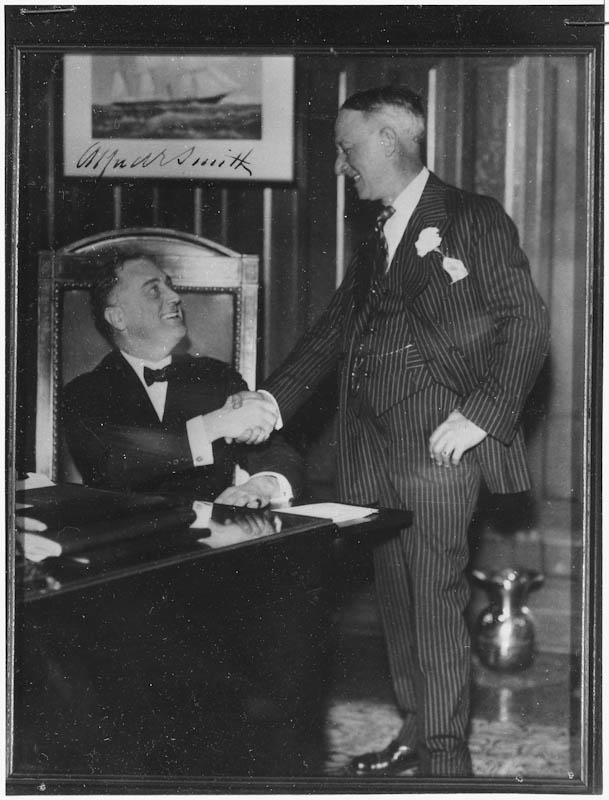
Posted in Franklin D. Roosevelt | 1 Comment